Viewing: CD project - View all posts

What is an Introvert like Me Doing, Performing on Stage? 


Here is an example of how God uses the foolish and weak things. My happy place is when I am alone, the space is quiet, and I am buried in a book or studying music without interruption. I can go many hours like this, content to be isolated from people. This works well for a classical pianist whose art demands a great deal of focus and reflection, not to mention the repetitive nature of practice. It does not bode as well for the performer. And here is the irony. That to be a performer of classical music, one must perform in front of people. 


I battle this reality, because it is in my nature to withdraw. What, then, is my motivation to perform? 

Music demands a listener. To some extent, the listener can be me, for when I’m at the piano I am creating as well as listening. But the music is not always satisfied with a single audience member. 

Classical music is unique to all other music that I know of, excepting jazz perhaps, in that it requires a certain level of focused study in order to bring it to fruition. This kind of study happens at least twice, once in the mind of the composer and second in the mind of the performer. One could argue that, if it is a collaborative or orchestral work it is also required of the director and conductor. One could also argue that it is required of the audience who listens. (And of course, there are the teachers and mentors and coaches!) There is something about the thoughtfulness that goes into composing and studying a classical piece, the discipline and effort required, the investment of these things--that demands an audience. 

Last year when I was working on recording my first classical CD I had in mind that I could straddle my introverted world with that of the performer in a happy medium, namely: recording a CD in the privacy and comfort of my living room, a “performance” that could be heard by vast numbers of people. And while this is true in a sense, the process of recording a CD is so far removed from a live performance situation, it really can’t be compared at all. I am left with the music, my introverted nature, the composers’ demands, and the necessity of an audience to listen. Here is where I think God has a great sense of humor. 

He calls people who are weak to do things completely out of their comfort zone. My personal belief in the reason behind it is so that we always have to rely on Him for our success. As a Christian, God’s Spirit lives in me and enables me to push past my insecurities and even at times my personality, in order to serve a greater purpose. In terms of me being a pianist, the purpose is to share this great music with a wider audience than myself. My security lies in who God is as my Father, Creator, Redeemer, and Friend. 

I was created to be a pianist. I was born into sin, which among other things, paralyzes with its doubts and insecurities. God, through the death of His Son, redeemed me from this paralyzing sin and set me free to live as He intended, not enslaved to my sin nature but freed to be and to do all that He intends as I depend on Him. As my Friend, I know God is with me on whatever stage He ends up placing me on, and He is for me even as I falter in my dependence on Him and am tempted to believe the insecurities and doubts that inevitably plague performers. In my weakness He is strong; I can do all things through Christ who strengthens me. This is not a female-empowerment message: I am woman, hear me roar! This is a God-empowering message: that when I believe in Jesus as the Savior and Redeemer of my soul, God moves in to strengthen and empower me to do the work He created me to do. And so I need not battle against my introverted self, but instead rely on the God who intentionally made me that way so that I might rest fully in Him!

Intention 

I am still in search of that elusive “it” that sets the professional pianist apart from the amateur. This is something I’ve been mulling over for the better part of the last year. I am more and more convinced that it has much to do with intention. 

The amateur performer relies to some degree on chance. She knows that preparation is important and spends many hours practicing, but there is always an element of unknowing – Will my hands make that leap accurately? Will I express at the keyboard exactly what is in my heart? Will I remember the notes in that difficult section? Will I start the piece too fast and watch it fall apart? Conversely, it seems that the professional approaches practice sessions quite differently. Instead of hoping things will turn out well 4 out of 5 times, she plans for things to turn out well. There is intentionality in the practice: If a phrase is not executed perfectly in practice, she will work on it, either through much repetition or through thoughtful problem-solving, or a combination of the two, until it can be executed perfectly every time. This takes an incredible amount of patience, focus, and discipline. 

I am continuing to work on the repertoire from my recent CD release. (Music is never really “done;” there is always something an artist can improve on.) As late as this morning, I found that I had been practicing some wrong notes (horrors!). 

The first song of my Ginastera set, the Creole Dances Opus 15, is slow and beautiful and wretchedly exposed. I question every phrase, every nuance, and every color of every note. The piece is a dance and should have a dance-like, lilting quality to it. But I don’t want it to be taken too literally - there should be some vague dreamy qualities as well. It is marked pianissimo, so it should be played quietly, but I also want it to sing. There are so many contradictions within the 90-second dance. Every decision is important. Everything “counts” because it is so exposed. As I play, I think I am over-analyzing, and I throw everything out the window and just play as beautifully as I can. But then, did I let loose too much? Some notes stick out at the expense of others, and other notes don’t sing as they should. The beginning of one phrase was taken too fast, and there should be more breathing room before going on to the next phrase. I play back the recording I made on my iPhone; it sounded better when I was playing it live! The recording forces me to listen objectively, away from the piano, and to consider what worked and what didn’t. I return to the piano to work more deliberately, slowly, and with greater intention.


Balancing Music and Motherhood 


This is the first year my children are all in school full-time and the year I have felt the most need to justify my not working outside the home. The question often comes up, “What do you do with your time?” The question is well-meaning, as it is an American norm to meet someone for the first time and ask, “So what do you do for a living?” The assumption that a mother has nothing to do when her children go off to school in the morning is laughable to me, but understandable in our culture where we often see mothers working full-time jobs and supposedly keeping it all together. If she can do it all, what indeed does a mother do during the day who is not working?

The short answer is: I do everything I did when my children were young and at home full-time with me, just without interruptions! Of course, I do not have the responsibilities of changing diapers and entertaining children, so my workload has decreased somewhat. This is where my music comes in. But first, a little background. 

When my husband and I were first dating, he in his early thirties and I in my late twenties, we discussed our dreams for the future. His ideal job was to own his own business; mine was to be a stay-at-home mom and do music. Many people stop there with the discussion, but our firstborn, type A personalities didn’t allow us to end it there. When we got engaged, we made some decisions about how we would make our dreams happen. At the time I was a public schoolteacher and my husband was a sales manager at Microsoft. We had some debt to take care of, but fortunately no school loans to pay off. We decided right away that we would not depend on my income to live on. Our plan was to get pregnant after a year or two of being married; if a child came sooner, this would not disrupt our financial situation. After about a year and a half I did get pregnant and gave notice at my job and then began my life at home as a mom. 

Fast forward ten years to today, and we have three school-age children, my husband has retired from Microsoft, and we own a flourishing business. Of course, a lot of details and drama happened in-between, and it has not always been easy. There were several years where my husband worked two jobs while I stayed home with two babies in diapers and a very extroverted toddler. We bought our first house at prime market rate and weren’t able to sell when we wanted to because we would have lost a significant amount of money in the market crash (We ended up renting it out for several years until we regained some equity and could sell at break-even). All in all, though, we have been blessed. The Lord has led us in our decision-making as we leaned on Him for guidance. We are both now seeing the fruit of the decisions we made at the beginning of our marriage. 

As to what I do during the day, maybe I should first explain what happens when the children come home. I pick them up from school (their school does not have bus transportation) and bring them home where they get changed, grab a snack, and start on homework. At this age, all three need some assistance with practicing spelling words, memorizing their Bible verses, studying for history tests (or Latin, science, geography, literature depending on the child and the week), and doing some extra math practice. It is not all hands-on for me, but I do need to hear the little one read aloud and we always review their graded work together to go over mistakes and celebrate successes. Depending on the day, it takes one to one-and-a-half hours to get through homework. By that time it is time to prepare dinner (or finish preparing, if I started something in the crockpot earlier in the day), eat together as a family, and then make lunches for the next day (the children are responsible for making their own lunches, with a little guidance). There is then about an hour of free time before we start the bedtime routine, where my husband and I take turns with each child individually, reading a story and Bible and praying before turning out the lights. Unless, of course, it is a gymnastics day for my oldest, and then I shuttle her back and forth to practice; or a choir rehearsal day, where I take off for the evening. We try to keep evenings low-key and enjoy time together as a family. Because of this, the bulk of my household managing and music “stuff” needs to happen during the day. 

A typical day for me, after getting the kids off to school, involves going to the gym, walking the dog, prepping dinner, doing some chores, and getting to the piano to practice. I play for a community choir that often sings music with a decently challenging piano part (or an orchestral reduction – we did Verdi’s Requiem this spring) and occasionally I lead a sectional and need to prepare what to rehearse. I also host house concerts once a quarter so I recruit musicians, program and advertise concerts, and prepare my own music to perform for those. I volunteer at my church as well, doing a little administrative work, some graphic design, and leading a worship team every other month. This all sounds very do-able on paper, doesn’t it?! The days are always full, though. Practicing solo and collaborative works and choir music, maintaining a personal website and one for house concerts, participating in online professional development groups and marketing my new CD take considerable time. Combine that with home maintenance, gardening, birthday planning, volunteering at the kids’ school, paying bills, and meeting friends, and my days are full. Managing a house and trying to have a personal life while raising children means there is always something to do. 

It is a most fulfilling life for me and I am immensely grateful to have the opportunity to stay home and invest so much in my husband and kids and home. These years are fleeting, and because we had our kids close together in age, it means we have about twenty years with them in our home (ten of these have already passed!) to nurture and care for them and teach them how to love and honor God with their lives and pursue their dreams. We intentionally make our family a priority, and because we do it means we make sacrifices in other areas. 

I love what author and missionary Elisabeth Elliot has said about choices: that a choice is a limitation. We are fortunate to have so many choices available to us in America, but we must realize that every choice limits us. Marrying one person means not marrying another; having X amount of children means there will be sacrifices of time and energy (and sleep!) and finances. For me, choosing to stay home with my kids means I limit the amount of travel and performing I do as a musician. I do this gladly, knowing it is only for a season, and that the investment I make in my children will reap far greater benefits down the line than growing a music career. At the same time, I am doing what I can to grow as a pianist. 

Last fall I recorded a solo classical piano CD in my living room on a considerably low budget with limited equipment. An additional financial investment has led to the album receiving radio play across the United States and it is on track to garner some important reviews and press. My relationship with my choir has led to recitals with new colleagues. I am exploring more avenues for performing during the day so that my involvement with music does not intrude too much on family life. Of course, both my husband and I see my involvement with music as a benefit to the children as well. They see how I work to perfect my music at the piano and what it takes to perform well. They get opportunities to see me rehearse in our home with other musicians, and they get to attend our house concerts where they meet all kinds of musicians and lovers of music. But I want to be careful that my music is not my sole focus. It is definitely a balancing act, trying to pursue what I love while being sensitive to the needs of my family. For now, in this season, this way of life is working for us all and the Lord is blessing it. How grateful I am to be able to embrace both music and family as I had dreamed many years ago.

Flawless Recording 

It takes courage to record. 

Recording is a completely different animal from live performing. It is under far greater scrutiny than a live performance. An audience tends to give grace in a live performance for small mistakes, missed jumps, a blurred pedal…perhaps because they get wrapped up in the shared emotional experience; listeners seem to share a sort of sympathy with the artist. In a recording, that grace is considerably lessened: the listening audience expects perfect execution down to the slightest nuance. Why is this? 

Perhaps it’s because when we listen to a recording we have a machine between us, or in some cases, many machines. We are physically isolated from the artist. Because we lack the ability to see the performer while listening– we don’t share the same space or breathe the same air or even hear the same sound - we’re removed from the immediacy of music-making. In the absence of the artist’s presence, our expectations for perfection go up and patience goes down. It is a curious thing and it makes the recording process quite intimidating. As an artist you feel even more vulnerable and exposed when you attempt to permanently etch your music onto a recording than when you perform on a stage. At least on stage there is some distance between you and your listener, a cushion of space that insulates you a little. As well, the fleeting nature of the performance is in itself a grace, as the listener can only “replay” a memory rather than a slightly imperfect performance. Lastly, there is an expectation of give and take in a live performance as the artist gives music to the audience, the audience receives it and gives back an immediate response. In live theater this is particularly telling, as a “good” audience can give incredible energy to the performers which then shows itself in their performance. 

For my Commonplace Beauty recording, I was determined to present myself as you might hear me in one of my living room concerts: to try to achieve the feeling of an intimate performance space where the music is immediately accessible. If there are any illusions in my recording, it is the illusion I tried to create of my listeners being there with me in my living room; the illusion of the give and take, of us sitting together in the same room and enjoying music at the same time. This desire to present as “real” a picture of me and my playing as I could brought up a few questions. For one, would I encourage my sound engineer to add reverb in the mix to make my piano sound bigger or to make my living room sound like a concert hall, or would we aim for as “true” a sound as we could get? For another, how much editing in the form of cutting and pasting the best “takes” would I ask for? When I first began the recording process, I was surprised at how many extra-musical decisions were required.  

I wrestled with the idea of splicing together “the best of” Cori. Of course I would like to be heard at my peak, but showing only “the best of” feels a little fake to me, especially if it cannot be easily reproduced in a live setting. I admit that I have a double standard, as I also come to listen to recordings others have done with the expectation that they will be free from errors. I don’t want to hear mistakes over and over again, and truly they can be a distraction from immersing oneself in, and being able to enjoy, the music. With my own music, though, I wanted to produce a beautifully artistic album that was “me” at the piano with no illusions, no barriers; as transparent as an electronically produced album could be. To me this meant minimal splicing (In the end, I made only two “cuts”); instead I chose the best version of each piece, even though it meant leaving in a few mistakes. 

A few years ago a company, I think it was Dove, put on a marketing campaign that showed women as they were without makeup, flaws and all. Their aim was to show that beauty can be found in every woman. My goal in Commonplace Beauty was the same: to show the beauty of music presented by a humble artist not covered up by fancy hair and makeup. At the heart of it is not a desire to flaunt imperfections, but a desire to reveal what God is doing in me. He made me, gave me talent, and is working in me to accomplish His purposes for me. He is perfecting me. I will always do my part to make my performances as perfect as they can be, but ultimately perfection isn’t my goal; reflection is. To reflect Christ’s beauty and perfection in my playing is my ultimate goal, and I will do what I can to remove any barriers I can in my musical performances. 

That said, I don’t intend to demean any artist who has chosen to cut and paste. Vladimir Horowitz, a pianist I have tremendous respect for, agonized over many takes and did what he needed to cut and paste his best playing into what he deemed an acceptable recording – but he lived in a different time. 

There is tremendous pressure on artists in this technological age to present a flawless image. How you present yourself to others is at the forefront of our minds now. There is much pressure to conceal flaws. I think we need to counteract this by boldly presenting true pictures of ourselves; again, not flaunting mistakes or being lazy about our art, but revealing the reality of the process truthfully as we seek to create the most beautifully poetic and excellently executed performances of music, and indeed of any art. This was at the heart of my creation of Commonplace Beauty, to offer my music with as much truthfulness and excellence as I could in a single album, mistakes and all.

How I Recorded a Solo Classical Piano CD in My Living Room 


how i recorded a solo classical piano cd in my living room

I recently released my debut classical piano CD, Commonplace Beauty, which was recorded in my living room! It all started about 13 years ago with the seed of an idea from a friend of mine who suggested doing a trilogy. 

At the time we recorded a Christmas CD (O Come, O Come Emmanuel), and the plan was to follow it up with a worship CD and a classical CD. I had participated on recordings before, but had never done a full-length solo album, so I was excited to be a part of this project. We recorded O Come, O Come Emmanuel in two days up at Icicle Creek Music Lodge in Leavenworth, Washington, and my friend and his business partner did the mixing and mastering as well as a good portion of the replication and distribution. Fast forward to 2017, a marriage and three children later, and I started thinking about tackling another solo recording. 

I was set on recording in my living room for a few reasons. One, I absolutely adore my piano, a Vogel by Schimmel grand that has the most shimmery top and a wonderful full bass. Two, I had this idea that I could record “at will” whenever I had a piece ready. (I have since revised this idea, after learning about how much is involved in the process.) Three, my children are all in school full-time, so I technically had “a lot of free time” (Any mother, working or stay-at-home, will realize the folly of this statement!). Four, I did not want to pay for studio time and be limited to a day, or three, of intense recording on an unfamiliar instrument. 

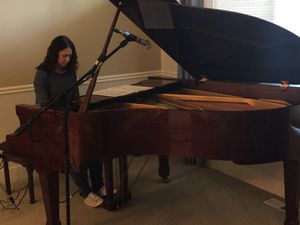
I began by playing around with my Zoom H4n voice recorder in different positions. It screws easily into a camera tripod and has several different recording settings. It gets a pretty good stereo sound and records to an SD card, which is easily popped into my computer. It even has a remote so you can position the Zoom several feet away and start and stop/pause recordings as you like. (By the way, I found the best position for it ultimately was in the crook of the piano, facing the back hinges, and just parallel with the top of the case. The lid was on full stick.) I listened to the files with Audacity, which is a free downloadable software program that allows you to cut and paste, add reverb and reduce noise, and much more. It is really a fun tool. I wanted a little more roundness to the sound, though, and so I began asking friends about recommendations for microphones. 

I borrowed a wonderful condenser microphone for a few months and tried plugging it into the Zoom (It has two inputs for microphone cables), but found it to be extremely sensitive, too much so for my use. I consulted with another friend who has a $1000+ set-up of microphones that actually clip inside the piano, which was intriguing to me, but that set up wasn’t exactly the sound I was looking for either (A little too close-mic’d and “studio”-sounding). I really wanted more of a live sound, where you would feel like you were sitting in my living room while I played (although I didn’t want it to sound like I just pressed “record” on my tape recorder!!). I then borrowed a Rode NT4 stereo microphone (pictured in the photo above when I was experimenting with positioning) from a friend and found that, combined with the Zoom, I had almost exactly the sound I was looking for. After several months I realized that the DIY approach was not going to take me all the way (YouTube videos and Google articles and experimenting were only taking me so far) and I put out a plea to friends for someone who had experience recording and mixing classical music. God led me to an old colleague I had played with years before who now is a piano technician, piano tuner, fabulous jazz pianist, and has 20 years of recording experience in his own studio! 

Tom came over to my house, consulted with me for almost two hours, and helped me find some sweet spots in my living room for placing the microphones. After he left, I spent a few weeks experimenting with placement and then started sending him files. Of course, then my piano decided to develop some never-before-heard clicks and squeaks, and so recording was delayed until we could find the culprits and solve the problem. Tom prepped my piano so that it would withstand multiple recording takes and I set aside two weeks to record. Every spare second, as soon as I got my kids off to school, the dog into the kennel on the porch, the fish tank filter turned off…and then waited for the landscapers to finish mowing, the neighbors to drive away to work, the airplanes to finish flying overhead, the wind to stop blowing and the rain to stop pounding…I would spend recording, making notes on “takes,” listening, and recording again. It was wonderful and stressful and intense and exhausting, but so rewarding when a take would come out satisfactorily. With my perfectionist tendencies, I wanted technically flawless takes so we wouldn’t have to do a bunch of cutting and pasting, and I *mostly* succeeded. With the exception of two pieces (I won’t reveal which two!), every song I recorded was done live, without edits. Tom did add some reverb and magic in his studio during the mixing process and I am pleased with the results. Of course, that wasn’t the end of it all. After the mixing is done, and the sound is the way you want it, you have to get the tracks mastered so that the volume is consistent from song to song and the timing between pieces is right. I sent the mixed files off to DiscMakers and after several long emails, a spreadsheet and a comprehensive phone call with the mastering engineer, we got to the place where I felt the album was “done.” 

For time’s sake, this is the condensed version of the process, and does not take into account the meetings with my graphic designer, the hours of planning and practicing, recording and listening and sending files to friends (months before the “official” recording ever took place), the endless hours of researching recording techniques and gear, creating my Facebook “musician” page, updating my website, blogging and updating social media with news about the recording process, figuring out how to set up an online store, figuring out how to license two of the selections on the CD that are not in public domain, and applying to CD Baby for online distribution. 

So now I’m “done,” right? Well…The CDs have been shipped to my house, are in the process of being sold, and now there is more work to be done in marketing and distribution. But the CD is finished! I completed this grand experiment of recording in my living room with bare bones equipment, no producer except myself, and a little help from my friends. It has been an incredibly satisfying year-long journey, and once I learn some new repertoire I think I’ll try it again!

Disclosure: Some of the links on this page are affiliate links, which means that if you click on a link and make a purchase, I may receive a commission. This commission comes at no additional cost to you and helps to support my music.

About Commonplace Beauty: My Debut Classical CD 


My debut classical CD, Commonplace Beauty, is now available for purchase through my website! It has been a work of love for the better part of this year, and I want to give you a glimpse of the thinking behind the album. 


FEELS LIKE COMING HOME 

In many ways this album is about coming home. I chose the name, Commonplace Beauty, from something that Charles Ives, an American composer, wrote about his Concord Sonata, and the Alcotts movement in particular. The sonata is a four-movement piece, where each movement highlights a different philosopher from the 19th century transcendental movement in America: Ralph Waldo Emerson, Nathaniel Hawthorne, Bronson Alcott, and Henry David Thoreau. “The Alcotts” refers to Bronson Alcott and his daughter Louisa May, the writer, and the family they formed together with Bronson’s wife and his other three daughters who lived in the Orchard House in Concord, Massachusetts. 

Ives talks about the “commonplace beauty” that was Alcott’s home and life, which was intertwined with a strong faith, an appreciation for art and beauty and eloquence of speech, as well as beauty found in nature. All of these things combined to make “home” for his family. I’ve always been drawn to that, particularly as I grew up reading Louisa May Alcott’s novels, starting with Little Women. When the movie came out in 1994, the Orchard House was exactly as I’d pictured: that sense of belonging, creativity and laughter, tears and an undergirding faith in God through it all. It embodied what I felt was the spirit of Louisa May Alcott’s writing. Charles Ives wrote this music celebrating this family and their life together. It resonates with me, as I also come from a family that is undergirded with a strong faith in God and of course, as a pianist, having an appreciation for art, music, and writing. In a way, playing this piece is like showing you what home feels like for me. 

CHOOSING THE PIECES ON THE ALBUM 

In thinking about the other pieces in this album, I chose pieces that I performed at different stages in my life that have special meaning to me, all driving “home” that idea of home! I grew up listening to my dad play Chopin and Rachmaninoff as I was going to sleep at night so there is a strong sense of nostalgia whenever I hear pieces written by those composers. I also play some Bernstein and Ives which may seem a little out of place among these other romantic composers, but who feel very at home to me. They are Americans; I am an American. That sense of nostalgia and the tradition of folk music, although not as common as it once was, is still part of our nation’s history and I feel like there’s a very distinct American sound brought to the forefront by Aaron Copland whose echo I hear in these pieces. These Bernstein, Ives and Ginastera pieces were all performed in my home at different house concerts over the last five years. It’s another part of home. 

When we started having kids, I quit my job as a teacher so I could stay home with them. I’m very fortunate to have a husband who is able to provide for us and who encourages me in my music. At the time I had my first child, the choir that I had been a part of for a considerable amount of time was disintegrating under a series of changes in leadership. We had been a 100-voice choir singing all kinds of repertoire touring the US and performing in different concert halls. The choir dwindled to a handful of people and kind of died, leaving a big musical void in my life. Of course, the choice to stay home, if you’ve had that same experience – you go from working full time and having a great community of colleagues – also leaves a bit of a hole in your social life. I was looking for an outlet musically and socially so I started playing with the idea of actually hosting these house concerts that I had been dreaming of. Our first one was about 5-6 years ago and we’ve been doing them about once a quarter since then. We have had all kinds of people in our home, and it’s been a wonderful opportunity for me to perform again and to be with my musician friends, as well as an excuse to bring in new musical friends and introduce our children to great music. 

MIXING GENRES 

One of the things I like to do in house concerts is to mix genres. I really like the juxtaposition of classical music with jazz, seeing how composers treat the same thematic material in different ways. I love to bring in different musicians and see how much we can learn from each other. That is part of the spirit of this album, bringing together seemingly disparate composers and trying to show musically how they can all fit together. 

The album opens with a Rachmaninoff Prelude and the Chopin Fantaisie-Impromptu, both of which are virtuosic and show off a fast finger technique, complimenting each other well. The B-flat Minor Nocturne follows the Fantaisie, being by the same composer, and having a similar spirit. But what do they have to do with some of these other pieces? Rachmaninoff and Chopin were contemporaries of Schumann. But why put them all on the same record as Ginastera, Ives, and Bernstein? I think the connecting thread for me is not only the personal one, having performed these pieces in and out of my home, but also that these composers had a strong sense of their own country and home. Maybe you can hear some of that in their work. In Ginastera’s dances, listen for some of the melodies and rhythms of his homeland. Chopin was known for his nationalistic way of composing. They all had a strong sense of identity with their country, so I think in that way they fit. 

There are a lot of short pieces on this album: the Schumann and Ginastera dances, the Bernstein Anniversaries… The Rachmaninoff is also a set of short “pieces” – musical ideas that are strung together to make a beautiful cohesive work. That is another common thread – these pieces of ideas and melodies that when put together make a beautiful whole. I think about that, even with the Fantaisie-Impromptu that has two very distinct ideas (fast furious fingerwork at the beginning and end, bookending a beautiful soaring melody). Chopin intentionally put these two parts together and they fit. All these things come together under the umbrella of Commonplace Beauty 

COMMONPLACE BEAUTY 

Sometimes we think of beauty as something elusive, something we admire and are striving for but can’t completely attain. I like the idea of this word “commonplace.” Beauty may seem high reaching, and yet we can find beauty anywhere. It’s a little bit magical that at the time I began recording this album it was fall. In the Pacific Northwest, this is the most gorgeous time of the year, with the red, orange, and yellow leaves exploding in color against the dark gray skies. It is something that happens every fall for about a month or two, and although we know it is coming, it somehow surprises and delights us each time it arrives. I think this is the idea behind a “commonplace beauty”: finding beauty in the everyday things. Music for me is a daily thing, but I don’t want the daily-ness of the practice to subtract from the beauty that is in it. Living together daily as a family, in a home, comes with a lot of “daily-ness” and even drudgery at times, but when undergirded with a spiritual foundation of faith in God, and a commitment to love, it can bring something beautiful to life. 

That is my hope with this album - that I am able to impart some of this beauty to you and your home, and that it will touch you in some way and leave you feeling as if you have encountered something beautiful. I hope you enjoy listening to it as much as I enjoyed making it!

Your Story, Guest Post for Piano Dao 

My parents never let me quit taking piano lessons. That, really, is the crux of my story. I did not grow up under a Tiger Mom, but from the very beginning, I grew up being surrounded by classical music. My dad and his three siblings all played piano, and my mom was my first piano teacher (That lasted about a year, until she decided I was better off being taught by her friend, and her friends’ kids were better off being taught by my Mom.) I would go to bed down the hall, hearing my dad practicing Chopin and Rachmaninoff. I would pick out tunes on the piano, and my mom taught me simple chords to accompany the melodies. I was a good sight reader early on and learned to fake my way through lessons, having neglected to spend much time practicing at home. It wasn’t that I didn’t love music; I really did love to play, but I did not have the drive to put much effort into it. 

Read the full article here

Becoming an Artist, Part 6: Memorizing Hard Stuff 

Memory has always been the hardest part of piano playing for me. I can sight read much of the repertoire comfortably (I'm not speaking about Faure or Ravel, haha!) but memorizing has always been a challenge. Case in point, I have been working on Ginastera's Suite de Danzas Criollas for about a year now and had memorized it in its entirety for a performance last spring...except for the third movement, for which I shamelessly used the score. But since I am including this suite of dances on my new CD project, I decided at the beginning of the summer to buckle down and memorize it. And I did it! It took me four solid months of procrastinating, whining, analyzing, and just sitting down and forcing myself to do it, and I finally have success! 

This particular movement contains a canon between the right and left hand: five itty bitty little measures that seem easy at first glance, but are filled with unexpected intervals, hemiolas, and unique pedaling challenges. I recorded a video of this canon this morning revealing some of my thinking behind memorizing this tricky section: 

If you're taking notes, you might notice me talk about these strategies:  

1. Analyze the shape of each phrase  

1a. Isolate the themes  

1b. Consider the harmonies  

1c. Check interval relationships  

2. Analyze chord types (major, minor, diminished, augmented)  

3. Watch the relationships between intervals (both on the page and physically at the keyboard)  

4. Notice when elements of the form repeat  

5. Compare sections to find similarities and detect differences  

6. Learn the last part first!  

Ginastera is a genius in how he strategically weaves notes together, similarly in thinking to Bach, in my opinion. The more you analyze his work, the more you see how the pieces fit together logically, even though when first hearing/playing you notice some disparate elements (like each hand being in a different key/mode). Taking the time to analyze a piece's form and doing a bit of harmonic analysis often helps me to solidify the physical memory my fingers have done and the aural memory my ears have accomplished. In fact, sometimes I start with the analysis and then move on to mastering the technique and expression. The more ways to secure this music in my mind and body, the better my performances tend to be!

Becoming an Artist, Part 5: Channeling Yuja 


I am continually amazed at Yuja Wang and her flawless live performances. How she can perform piece after piece on different pianos, without having a lapse in concentration, a memory slip, a slight miss on a jump, is incomprehensible to me. 


I have been working on Rachmaninoff’s Prelude in G-sharp Minor for months now. It has been fully memorized for quite a while, and I have worked out technical challenges, dealt with memory slips in different places, and grown in expressing my interpretation and style. I have recorded quite a few “takes” as I have experimented with different microphone set-ups. BUT…not once have I recorded a perfectly executed “take.” I’m close…so close! But I am still striving for that consistency that comes from mastering a piece and performing it often (and maybe practicing more deliberately, or thoughtfully, or frequently?). 

Horowitz and Cortot and Rubenstein and so many of the great pianists who have since passed away did not concern themselves so much with flawless performances. They were more interested in delivering a truthful and passionate interpretation. However, our standards have changed. We still want original interpretations delivered with passion, but we also want a flawless delivery. We are used to recordings where mistakes are edited out and instruments are technically enhanced by modern mixing so that we hear what we deem perfection. 

I read a great article recently titled “The Difference Between Amateurs and Professionals.” A couple statements stood out to me: 

"Amateurs stop when they achieve something. Professionals understand that the initial achievement is just the beginning. 

Amateurs value isolated performance. Think about the receiver who catches the ball once on a difficult throw. Professionals value consistency. Can I catch the ball in the same situation 9 times out of 10? 

Amateurs go faster. Professionals go further." 

I’m working on slowing down, evaluating my work more critically when I think it is “done,” and becoming more thoughtful at the keyboard. Instead of reacting to what my fingers play, I want to be deliberate and purposeful, thinking ahead of my fingers (while at the same time hearing and reacting to what they are doing) so that what results is not a mistake or a lucky performance, but a true representation of how I feel the music ought to be played. After all, I am an interpreter at the keyboard, trying to marry the composer’s intent with my God-given personality and passion. Yuja does it her way, Horowitz his, and now it’s my turn. 

Here is my “so close” interpretation from this morning’s practice session:


Becoming an Artist, Part 4: Working with Pawel Checinski 


I had the most amazing piano lesson this month with Pawel Checinski, the teacher of one of my pianist friends. We met formally for an hour, and as often happens with a master teacher, I was given enough material to work on for the next few months! 


I had not had a piano lesson since my years as an undergrad, so I was a little hesitant going in. My inner critic is enough of a challenge as it is, and a lesson felt quite intimidating at first. However, I was met with the most encouraging and constructive feedback - not “soft” by any means, but specific and delivered with absolute respect. (Incidentally, I witnessed this as an observer the weekend prior as I watched Checinski work with high school students in a masterclass. At no time was he condescending or impatient, but he continually gave students tools to develop their musicality.) 

I learned so much as we worked on the Chopin Fantaisie Impromptu and the Rachmaninoff Prelude in G-sharp minor that if I shared it all here, you would grow weary of reading. I will try to be brief and share a few highlights: 

1. When trying to figure out what you want musically, isolate the melody. Play the melody by itself (no accompaniment or harmonies) and shape it. Breathe where a singer would breathe. Sing the line; draw the line in the air; find the arc. Then add the other notes and accompaniment back in, trying to keep the same shape of the melodic line. (In my pieces, the melody sometimes happens in the left hand on top of chords, so isolating the melody means taking it off the chords for a minute.) 

2. Rachmaninoff’s sound comes in waves. Dynamics must have big contrasts. Decrescendos should come down at the same rate as crescendos go up. Don’t go soft right before peaks; carry through the whole crescendo to the top and complete the phrase. 

3. When rolling bass chords, keep the bass note in the pedal. This may mean pedaling earlier or rolling the chord faster. Be a magician – trick the listener with a slight of hand, a quick pedal right after you touch the note, so that the bass will be heard. 

We also worked a bit on dropping arm weight into the key and resting. I tend to press into the note and then keep working, as if sound would continue to come after the hammer strikes the string. 

Pawel is a great storyteller. In addition to the musical coaching, I was treated to quite a few stories including one where Rachmaninoff hated the C-sharp Minor Prelude so much that he referred to it as “It.” Sometimes he would play the first three descending chords and then go into the Chopin Fantaisie-Impromptu just to spite the crowds; other times he would tell an audience he had forgotten it! 

In the weeks following my lesson I have tried to apply what I learned to my playing. I still have a lot of growing to do, but I am so grateful for the time I spent with Pawel and the musical wisdom he passed on to me. I’ve recorded an “after” session of me working at the piano on the Rachmaninoff. If you are not yet tired of hearing me work on it, maybe you can glean a few tidbits from my work with Pawel for yourself!

Keep up with my writing by subscribing to the blog on Feedly or to my monthly newsletter.


Becoming an Artist, Part 3: Developing True Artistry 

Listening to myself play on a recording is quite eye-opening. Stepping back from behind the keys and hearing myself play gives me a new perspective, unclouded by what I “think” I sound like! From this position I am far more attuned to nuance and shape and color, or the lack thereof. I listen to recordings by amazing (famous) pianists like Arthur Rubenstein, Sergei Rachmaninoff, Vladimir Horowitz, Murray Perahia, Yuja Wang, and hear incredible sensitivity and attention to detail, beautiful tone colors and impeccable technique. Even their mistakes are artistic!

What is it that sets these wonderful pianists apart from an amateur? How does one develop the kind of artistry that holds the attention of the listener, that inspires, that awakens emotion? It is more than technical perfection, even more than reading exactly what is on the written page or interpreting it in the intended style of the composer. And this “it” – can “it” be taught, learned? Is it an intuitive musical sense that is born in a great performer and flourishes over time? If one has “it,” how can it be further developed and polished? What makes a true artist? 

All of these questions run through my mind as I pursue this project, recording myself over and over, tweaking things, listening to other pianists play, seeking constructive criticism, returning to the piano yet again. I realize that there is never an “end” to becoming an artist - that even the great pianists never stop being critical of their own playing. But I am hopeful that with each recording “take” I am getting a little closer to becoming a true artist, able to make music in such a way that it grabs hold of you at the deepest level and touches you somehow. At any rate, although I have been making music for a while, I feel like this CD is a new beginning as I think about my playing in a different way, practicing and reflecting and polishing on my way to Becoming.

Becoming an Artist, Part 2: Creating a Life in Music 


In my life, I have been fortunate to ride on the backs of mentors who had incredible vision and admirable work ethic. Because of them, rarely have I felt the need to create my own musical path or seek opportunities to perform. Where I’ve lacked vision and direction at times, opportunities have come knocking…to music-direct my first mainstage theater production in the 90s; to take part in several world premieres; to perform in the world-class Benaroya Hall… 


I met my husband in 2004 playing volleyball with our singles’ group from church. When we began dating we were both tired of the dating “game” and dove straight into sharing our visions for our futures. My husband is an entrepreneur and had all kinds of ideas for inventions and businesses. I had one idea: becoming a stay-at-home mom and doing music. With God’s direction and blessing, we married and set out to make our dreams come true. 

I have been inspired big-time by my husband. He did not have opportunities “come to him” as I did; instead, he has always set out to create his own opportunities. (As I’ve witnessed this over the years of our marriage, I have come to realize that all of my musical mentors did the same thing!) His vision and discipline in the business sector have taught me a lot about accomplishing big dreams. When he asked my dad for permission for my hand, my dad told him to not let me “let go” of my music, and he has taken that seriously. Because of him, I began pursuing a choral accompanying position…and ended up playing for my beloved Kirkland Choral Society. Because of him, I have a dedicated “piano room” in my home where I can practice and rehearse with other musicians. Because of him, we have hosted house concerts for the past five years, where all kinds of musician friends have come and filled our house with music. 

This year I decided to make some waves in my musical journey by working on a CD project – my first solo classical piano CD – as a way to celebrate a milestone birthday and to share my music with friends and family. My vision is to record some of my favorite music on my beautiful Vogel piano in my living room. This time I am not waiting for someone to plan this project for me. I am not expecting anyone to invite me to record. I am dreaming a big dream and pushing to find ways for it to happen. I can’t wait to see how it turns out!

Becoming an Artist, Part 1: Pursuing a Life of Music 


During my time as an undergrad my days were full of music-making: accompanying operas and musical theater productions and choirs and voice students, working on my piano performance degree, preparing for recitals, and imagining life after graduation filled to the brim with music, specifically in the field of opera accompanying. 


After graduation my career path twisted and turned through years of piano teaching, choral accompanying, musical theater directing, administrative work at a church, public school teaching (classes of first graders, not music), and mothering. At times my life was musically full with gigs, solo piano work, and piano teaching; at other times, work and daily life threatened to all but smother my music-making. There is something about becoming an adult and having responsibilities, and especially adding children to the mix, that threatens to take away the time and freedom to make music and develop musical colleagues. Achieving work-life-music balance becomes incredibly difficult, a challenge that is brought up repeatedly in the musical Facebook groups I am a part of. 

Of course, there are the musicians who go all out for their art and end up sacrificing family in big ways as a result. And the other extreme – those who had musical potential and a musical life at one time but who are swallowed up by the need to provide financially for family, and in other ways as well, and whose music goes by the wayside. Both extremes often end up in some kind of regret. 

I am fortunate to be in a season of stay-at-home Mom-ness, where I have the best of both worlds – the financial support of a husband and the fulfillment of raising a family, and the ability to pursue music on the side. Still, as any parent knows, time to pursue personal interests must be planned for, squeezed in here and there, between family responsibilities. 

What it looks like practically these days varies, especially as we’re in the middle of summer and my kids are all home with me. I try to get in some practice every day, usually between 30 and 90 minutes (in the morning after breakfast and/or in the evening when my husband finishes up the dinner dishes). I am trying to complete memory on a couple of pieces for my CD and finesse a few others that are fully memorized. My focus is not where I want it to be, and listening to music for the purpose of reflection and analysis happens rarely. (Other listening, to Disney soundtracks and summer-y popular and folk music happens quite often in the kitchen, surrounded by dancing kids!) However, I have started thinking that practicing the piano in the summer at home with kids is similar to tracking a toddler’s diet: You have to look at what happens over the course of a week to determine whether the intake/output is healthy and conducive to growth. So I am trying to look at my bit-by-bit, inch by inch practice more holistically, over the course of a week, in order to see that I am making progress. 

I would love to hear how you make time for music, or any other artistic endeavor, with or without the distraction of kids. Are your days of practice a roller-coaster like mine, imitating a toddler’s daily diet?

A Little Improv... 

One of the pieces I'm currently working on is Chopin’s Fantaisie Impromptu No. 4 in C-sharp Minor. I have been mulling over the title "Impromptu" and trying to wrap my mind around his reasoning behind it. What makes this piece an impromptu, an improvisation? Did Chopin sit down with a C-sharp minor chord in mind and start playing this fantastic elaboration?

Did it sound like this at first?

Chopin was experimenting with a relatively new “form” in 1834 with this impromptu. Although not technically a musical form (such as a “sonata” which has a very definite theme, development, and reiteration of the theme*), the term describes more of an improvisation of ideas. As an admirer of jazz piano, I love finding these jewels of improvisation in the world of classical music, and I am blown away by the actualization of Chopin’s improvisatory ideas.

It seems relatively simple – the development of a minor chord structure – but what Chopin begins simply in the left hand twists and turns at a rapid pace when it enters the right. After showing off a bit, he slows to a beautiful lyrical section that plays around with the same chord structure in a different key. Afterwards, Chopin returns to his initial improvisatory madness with a few surprises at the end. 

I adore this piece. I remember my dad playing it as I tried to drift off into sleep in my childhood (Never mind the numerous times I came out of my room to tell my parents his playing was “too loud”!). This morning I listened to Arthur Rubenstein’s set of all four impromptus written by Chopin. Thank goodness for YouTube. What wonderful pieces! 

Donald Alfano wrote a fascinating article on them which explains that the fourth impromptu contains material from which the others are derived (So perhaps it should have been called Impromptu No. 1). The difficulty with the numbering lies in the fact that Chopin never published No. 4. It was published posthumously by his friend Julius Fontana in 1855, against Chopin’s wishes that his unpublished works should be burned upon his death. Interestingly, Rubenstein later came across a manuscript of No. 4 through an auction sale and found an inscription to a baroness, which suggests a commission was made for the piece. It could be that the baroness owned the rights to the composition following her purchase, and thus Chopin did not feel free to publish it on his own. 

Horowitz and Rubenstein have some fabulous recordings of the fantasy, using almost no pedal. There is a wonderful collection of recordings, including theirs, on the website of the Fryderyk Chopin Institute.

*For a detailed, and highly entertaining, explanation of sonata form, see Leonard Bernstein’s Young People’s Concert on the subject.

Recording Trials 

I’ve been sitting down at the piano quite a bit lately trying to find good mic configurations for recording my piano in my living room (actually, we call it "The Piano Room.” I have a Zoom H4n recorder that I have used successfully to record our live house concerts. It is a wonderful device that I can listen to in “real time” with headphones, adjusting the recording volume as I play. It is a whole different ballgame, however, trying to use it for a studio piano recording. To round out the sound, I am borrowing a condenser mic from friends that is super sensitive. I have tried a few different placements. It seems the condenser does best inside the raised lid, about halfway between the lid and the strings. I can duplicate the condenser’s mono signal and reverse it in my editing software to get a stereo sound. I am hoping that between the condenser and the Zoom I can accurately capture the shimmery goodness of my beautiful Vogel grand piano. 

A few things I’ve learned about placement – putting the mic close to the lid gives a warm reflective sound, but can be a little too bright. Putting it close to the strings gives more hammer noise and pedal noise. For balance, the mics need to be about halfway between the lid and the strings. Also, the condenser and Zoom seem to need to be within 36 inches of each other. 

For a while I attached my Zoom to a camera tripod and balanced the tripod on top of a speaker to get it high enough to “see” into the case of the piano.

Placing it in the crook of the piano and getting it as close to the piano as I could gave me almost what I wanted in terms of sound. However, I wanted to experiment with getting the Zoom over the mid-range or bass of the piano, not just the treble strings. So I purchased a GoPro music kit that contains a clip that can attach either to the lid of my piano or to the music stand. It comes with two extension attachments, one about 2 inches long, and the other about 5 inches long. To connect my Zoom to the clip I use a camera-converter made by GoPro. What a fun device! I can position the Zoom anywhere now and angle it using the hinged extensions. It gives me so many more options over my original setup. 

Testing the Zoom out with the GoPro kit today, I tried both attaching it to the lid and to the music stand, alternately. Although I got great sound attaching it to the lid, I continually got a buzz, either due to the vibration of the kit against the lid, or the close reflection of the device to the lid. Warm, but too bright and buzzy. I then tried attaching the Zoom to the music stand, toward the bass strings, with the condenser pointing towards the treble. This happily cut out the buzz and I think I’m getting closer to the sound I want. You can hear a sample of this in this excerpt of Rachmaninoff’s Prelude in G-sharp Minor.

Here's another clip, this time with the Zoom attached to the side of the piano. Can you hear a difference?

Practicing... 

Trying to make good on my goal to have three (or more) pieces "at hand," I have been working on Rachmaninoff's Prelude in G-sharp minor (Op. 32, No. 12) this week. I played a little of it for a friend who came over Friday evening and asked me, "What can you play?" (He'd been reading my blog!)

Alongside practicing, I have started a Page on Facebook as well as a YouTube channel so you can follow along with my progress. Below is a peek at part of today's practice session:


What Can I Play? 

I just read a great article about having pieces "at the ready" to play. It spells out my experience as a classical pianist so well - the tendency to consider time at the piano as work; constantly working to get music up to performance level before performing it and moving on in favor something new. When I am continually learning new pieces, it is easy to feel as if I have nothing to play. Mastery happens just before performance and then gives way to the challenge of learning new music. Yet Andrew Eales argues that we should always have three pieces mastered and ready to play without music, at a moment's notice. And why shouldn't we?

Instead of being relegated to playing the first few pages of Fur Elise that I learned in junior high, or improvising a chord progression, why shouldn't I have a mini arsenal of enjoyable, challenging classical repertoire that I can proudly show off as I enjoy the fruit of my labor: seeing the pleasure on the faces of those I share it with?

As I take steps toward recording a classical CD this year, one of my goals is to develop a handful of pieces that I can play beautifully, skillfully, and without music. You can hold me to it! The next time you see me by a piano ask, "What can you play?"

New Year, New Project 

There is a longing in me, deep down, to write. I want to share ideas, encourage, inspire, console, comfort, love...through my words. I aim to do this with my piano playing, too, and I think that at times the music is far more effective than any word I might speak with my mouth.

I want to do better at both this year - playing and speaking my words. So once again, after a long respite, I return to this blog, hoping something I write might "speak" to you.

Since it is a New Year, full of promise and possibility, I have been dreaming again. My main goal this year (besides living well my roles of wife and mother and Christ-follower), is to record a CD! It has been a long time coming, but I am determined to make it happen THIS year. Mainly because of a birthday milestone of mine (ahem), but also because every Christmas I receive a few notes saying how much my friends enjoy listening to my Christmas music. Somehow it speaks to them...and I want to continue speaking in this way as long as I am able to play.

So...the program is set and I am back again at the piano, striving to spend a little time each day doing something towards my goal. That means I am sometimes at the keyboard, working out fingerings, bringing music up to speed, memorizing...sometimes at the computer with my score listening to others' performances, making notes, analyzing chord structures and form...sometimes listening completely outside of my program to find inspiration (Currently I'm listening through a list of pieces showcased on this season's UW President's Piano Series)...and sometimes looking up recording how-tos on YouTube, playing with my Zoom recorder, and researching the best way to produce, package, and market the new CD.

I've decided all of this "counts." It's easy for me to feel like I haven't accomplished anything if I haven't been at the piano on a given day. But in reality, there are a lot of pieces that make up me as a whole musician, and so for this year, I've decided any bit of music "work" that I do in terms of moving ahead with this CD and in furthering my "wholeness" as a musician will count.

(And that includes writing this blog...so I can check that "accomplished" box today!)

In reality, of course, I need to be at the keys, head down, in the music much of the time. But in giving thought to the whole creative process, there are a lot of "writer's block" moments that I have simply because I waste time and energy on things like procrastination and lamenting "not having practiced today." I want to keep the creative momentum/drive/inspiration/muse going so that it fuels this project and my playing, in a positive way.

And so, onward! There is much to be done!