Viewing: Games and activities - View all posts

Beginner Piano Lesson Games 

Playing games in the piano studio is a great way to introduce and review concepts, change the pace of a lesson, and have fun around music! 

I especially like working games into lessons with my younger beginner students: playing with animal erasers, getting off the bench and onto the floor, and sometimes introducing a wee bit of competition! (Watch this with your young ones, though - often a cooperative game will be a better choice for preschoolers.)

Some of the concepts beginners need help with are:

  • Left and right
  • Finger numbers
  • Musical alphabet
  • Names of the keys on the keyboard

Left and Right

First, establish how a student will tell their right hand from their left. Sometimes we refer to a student's hand as “the hand you write with” or “the hand you throw a ball with.” I like to have students put their hands in the air in front of them, facing out, and form an “L” in each hand using their thumbs and pointer fingers. Only the left hand will form a proper “L” for “left.”

Play a simple Simon Says game, where you call out directions and the student puts their left hand on their ear, or their right hand pats their shoulder, or their left hand touches their shoe, etc.

Finger Numbers

Do a simple “finger warm-up” where the student puts his hands in the air in front of him, and then you call out fingers to wiggle: “Wiggle your ones” (thumbs), “wiggle your twos,” and so forth.

Trace the student's hands on a piece of paper. Toss a pom pom, cotton ball, or penny on the paper, trying to land on a finger. Ask the student to name the hand (left/right) and the finger number that the object landed on. If you'd like, have the student label the finger number with a pencil. Continue playing until all fingers have been labelled.

Musical alphabet train game beginner piano

Musical Alphabet

Students can practice their musical alphabet forwards and backwards with this simple train game! Additionally, they can practice finding “what comes next” and “what comes before” when given two consecutive letters of the alphabet.

Names of Keys on the Keyboard

Animal rescue and race beginner piano game printable

Animal Rescue and Race is a set of two beginner piano games that teach keyboard geography and direction.

In Animal Race to the Top, students construct a paper keyboard on the floor and then choose letter cards to race animals from bottom (left) to the top (right) of the paper keyboard. 

In Animal Rescue, animals are running loose in the zoo! Students must draw a letter card and put the animals back in their proper “cages” by finding the corresponding keys on the keyboard.

Of course, you can play both of these games right at the piano, too! But if your students are anything like mine, they will enjoy an opportunity to jump off the bench and play a game on the floor for a few minutes at the end of their lesson. (Maybe you will, too!)

Penguin piano build a keyboard printable game for beginner piano students


Penguin Piano is an extension of this activity. I like to use it as a take-home assignment that follows our games of Animal Rescue and Race. Students can take home one worksheet to cut and paste, or they can take home two sheets and race a parent or a sibling to form a proper keyboard with labelled keys.

You can find these last 3 games in my shop, as well as other resources for teaching piano! All come with a studio license, so you can print as many copies as you need for your students.

What are some of your favorite games for beginning piano students? Let me know in the comments!

Keep up with my writing by subscribing to At Home with Classical Piano on Substack.

Introducing...The Scarlatti Composer Kit! 

Scarlatti composer kit

I had so much fun putting this Composer Kit together! The life of Domenico Scarlatti is fascinating - his encounters with royalty, his different stylistic periods, his infamous duel with George Frederick Handel in Rome…and his experiments at the keyboard offer much fodder for discussion and exploration in student compositions!

Scarlatti wrote 555 keyboard sonatas, although not in the sonata-allegro form that we are familiar with in the Classical era. His sonatas are often in two parts, and include techniques like imitation, counterpoint, fast repeated notes, and crossing hands. He also plays with Baroque dance form and fiery dance rhythms from Spain, definitely a “Renaissance man”!

Students will love engaging in a Tic-Tac-Toe duel of organs and harpsichords, creating copycat fugues in a fun group game at the piano, and trying their hand at composition in the style of Scarlatti.

The Scarlatti Kit, like all of the Composer Kits in my shop, contains a 1-page biography (one sheet at the intermediate level, and one for younger readers), two games suitable for playing student-teacher or in a group setting, a playlist with suggestions of what to listen for, and a composition activity (one for beginners and one for intermediates).

I use these kits in group lessons once a quarter, but the materials are also great for composer study within private lessons, in homeschool co-op music classes, or as an independent take-home activity.

Find the Scarlatti kit here!

For more Composer Kits and a free resource, check out this link!

Taming the Group: Management Strategies for Piano Teachers 

As piano teachers, we often choose to teach private lessons because we like the one-on-one relationship with our students. We typically teach out of our homes and have introverted personalities, enjoying the freedom to teach a block of lessons and then take a break to re-charge. This is my preferred approach 😊; however, there are also times when we want to build community in our studio, giving our students opportunities to perform for each other and get to know other pianists “like them.” This can take the form of recitals, holiday or end-of-term piano parties, summer piano camps, monthly workshops, or quarterly group lessons. But what is a teacher to do who isn’t comfortable managing groups of students?

In my late twenties I transitioned from being a private piano teacher to teaching first grade in a public school. While I had worked in Vacation Bible Schools for years and even ran an after-school program at a YMCA for grade-school students, managing kids in a more formal learning environment required me to have an even better grasp on management strategies. Here are some tried-and-true tips that I learned during my teacher training that can help you lead a successful camp/workshop/group lesson, whether you have a group of 4 or 30 students:

Keep your rules short and memorable: Be kind and have fun. 

Explain your rules: Be kind means that we will listen when others are talking, be respectful in what we say, etc.

Explain the consequences for unwanted behavior:

  1. Verbal warning
  2. [Short] time-out away from activity or must sit with the teacher
  3. Talk with parent at the end of camp

Have a plan for getting students’ attention when it gets loud. Choose one of the following or make up your own: 

  1. I clap a rhythm and you clap it back; 
  2. I say, “Campers, attention please!” and you put your hands in the air and look at me; 
  3. I say, “Give me five” and you respond with eyes on me, ears listening, mouth quiet, hands to yourself, heart ready to learn.

Yelling over students’ voices is never effective. If you have verbal instructions, wait until there is a drop in the noise level, and then take advantage of it by calling students to attention. If there is no drop, try recruiting students one at a time by saying “If you hear me, clap once,” then, “If you hear me, clap twice.”

It is best to practice your call-to-attention before you need it, so do it often in the “honeymoon” phase of the first day. Make it a game to see who listens first!

Befriend your tricky kids. You know the ones – the kids who, if given the chance, will act out and pull your whole group quickly into chaos. Know their names, make a point to connect with them early in the day, and keep them close. Assign them a job that gives them positive attention. 

My best management strategy is to get ahead of disruptive behavior by befriending kids, setting clear expectations, and having a plan in place for bringing the group back to attention. With a little forethought and consistent follow-through, you can have a successful and enjoyable time with groups of students!

Need a plan for a 60-minute group lesson? Check out my free Group Lesson Planning template below:

group lesson planning template

Keep up with my writing by subscribing to At Home with Classical Piano on Substack.

Music of the World Piano Camp 

This summer I ran two piano camps for my students and any interested friends/siblings/potential students. One was Joy Morin's “So You Want to be a Composer?” and the other was her “Music of the World” camp. Both curriculums are fantastic and served my two groups of students well.

I've written about the composer camp elsewhere, but in brief, I ran this camp with six 6-12 year-olds: two current piano students of mine, two students who take Suzuki violin lessons, and two former campers with some beginning knowledge of music and the piano. Since it was a smaller group, I was able to give individualized attention to students as they worked on their own compositions. The curriculum definitely requires kids to have the ability to listen and discuss music in a focused manner, although it has plenty of variety to keep everyone engaged and having fun!

The second camp I ran was Joy's “Music of the World,” and this was with an entirely different group of students! I hosted 11 kids for this one, more on the younger side (several 6-year-olds) and in their beginning years of piano. This was a very craft-heavy camp, as each day we cut and pasted facts and illustrations related to each country into a “lapbook” that the students could take home. Kids also had the opportunity to make an instrument each day.

Because I knew I had a younger group (and a lot of siblings!), I researched some outdoor games to supplement with. We ended up playing an egg-and-spoon game for our visit to Australia, throwing pennies into a frog's mouth during our time in Peru, kicking hacky sacks on the day we visited China, and playing mancala (with egg cartons and beans!) when we went to Ghana.

Many of the campers from both weeks had attended my Piano Camps for beginners last year, and they were thrilled to be back for more.

If you're looking for a ready-made camp curriculum for your students, check out these camps by Joy:

So You Want to Be a Composer?

Music of the World

And my camps designed for beginner students with 0-2 years of piano:

The Great Music Race

Musical Secret Agent

What other camps have you hosted in the past? If you have a curriculum to recommend, leave a link in the comments!
Keep up with my writing by subscribing to At Home with Classical Piano on Substack.

Group Lesson Planning Made Easy 

Group lesson planning made easy

Let's talk about Group Lessons! I'm not talking about regular weekly piano lessons with a group of students; rather, a once-a-month or once-a-quarter get-together with your private piano students where students perform for each other, play games to reinforce music theory concepts, and learn about a topic in music history like a composer. In my piano studio, we call them “Piano Parties”!

Group lesson “Piano Parties” are an essential part of my piano studio offerings. So much of piano study is done in isolation that we forget there are others “just like us” who are learning and pushing through challenges at the piano bench! It is important for students of all ages to experience music in community with others, to hear others play, and to collaborate in fun musical experiences. My group lessons serve to form community among the students, provide for more in-depth teaching time and reinforcement of music theory and history concepts, offer a welcoming space for informal performances, and give me time every 4-6 weeks to offer make-ups or work on admin/lesson prep. 

Two big questions always come up: “How do you structure your Group Lessons?” and, “How do you schedule your Group Lessons?”

STRUCTURE

My Group Lessons always follow a simple format: an opening game, student performances, learning about a composer, and closing games. I have a collection of music theory games that are accessible to beginner and intermediate students of different ages and are easy to incorporate in a mixed group setting. I've put together a free Group Lesson template (click HERE to get yours!) of my schedule, along with a resource list of over a dozen music theory games and suggestions for composer-focused activities that you can use to help guide your planning.

group lesson plan template free printable download

SCHEDULE

It can be tricky to schedule private students for a group lesson. The way I accomplish this is by publishing a calendar of my private and group lesson weeks for my piano families, and releasing it in the spring so that families can plan for them. Group lessons take place during my normal private lesson days and times and are in lieu of the students' private lessons for that week. So, for example, if I teach half-hour private lessons on Saturdays from 8:30am-12:30pm, I will schedule an hour group lesson on a Saturday from 9:00-10:00am. This overlaps the normal time of some of my private students, and isn't too far off from the remaining students' lesson times. I schedule the same way for my weekday lessons.

Group lesson games

There are always families who have a conflict on some week or other, and they may opt to come to a different group lesson day that particular week, or if that doesn't work, they miss the lesson altogether. In the latter case, I will send home the activities/worksheets from the group lesson for them to complete on their own. 

Because I operate my studio on a tuition model, group lessons are bundled into my studio offerings for the year and are subject to the same “no make-up” policy as that of my private lessons. 

I hope this helps you think about how you can make group lessons a part of your piano studio and takes some of the guesswork out of planning a fun and productive time with your students!

Click HERE to get your free Group Lesson template!

Let me know if you have any questions in the Comment section below!

Keep up with my writing by subscribing to At Home with Classical Piano on Substack.

Summer Piano Lesson Ideas 

For my piano studio, students have the option of taking 6 weeks of lessons in the summer in addition to, or instead of, attending a Piano Camp. Because we work so hard during the year, and because there are often areas in which students can use a bit of review, I like using the summer to “go sideways.” 

If you are unfamiliar with the term, going sideways means learning music at the same level that a student is at, intentionally staying there in order to solidify concepts. This can happen at any time during the school year when it seems a student isn’t fully mastering a piece before it feels like it’s time to move on. Summer, with its laid-back feel, is a great opportunity to “take a break” from your regular piano lesson plan and review concepts through games and new music.

If you use method books, you will find that the pacing is just right for some students, but far too slow or even too fast for other students. This is one reason you will find a lot of “supplemental” books at one level – so that a student can continue to work on the same rhythmic, melodic, or harmonic concepts to achieve mastery before learning something new. 

BEGINNER STUDENTS 

For my beginner students who need sideways practice this summer, we will be working through a same-level method book. Since we are using Faber Piano Adventures, this will likely be a Rock ‘n’ Roll, Jazz and Blues, or Disney book! 

We will also be playing games to reinforce finding the landmark keys of treble G, middle C, and bass F on the piano, and recognizing stepwise direction on the staff (up/down, left/right), as well as reviewing the rhythmic names and values of notes and rests. These are common challenges for beginners, and developmentally appropriate for them as they are learning similar concepts in literacy at school (recognizing letters and phonemes and sight words, reading left to right, and developing fluency in reading combinations of words). 

Animal Rescue and Race is a great way to teach and review keyboard geography 

Rhythm Playing Cards are fun to use when learning rhythm symbols and their values

INTERMEDIATE STUDENTS 

Intermediate students may study method books during the school year or work through the myriads of piano literature available for them. Summer lessons might look like working on duet literature, practicing sightreading skills with fun music a level or two below their current level, or focusing on music in certain keys to reinforce reading in a key signature and correct scale and arpeggio fingering. Alternatively, students might like to try out a specific genre, exploring jazz, gospel, pop, or celtic music.

I also like to introduce my intermediate students to lead sheets. This is a fun way to teach harmony and chord inversions, and to give students an opportunity to experiment with improvisation and transposition.

Rodgers and Hammerstein Piano Duet Book is one of my favorites to work on with students!

Chrissy Ricker has a variety of free resources in all of these areas 

ADVANCED STUDENTS 

Advanced students often have competing interests, full schedules during the school year, and even a work schedule to navigate. Summer can be a good time to explore a genre they are interested in, have fun sightreading duets together, or listen to a variety of music by one (or several) composers to help narrow down choices for study in the new school year. 

Check out IMSLP for classical music in the public domain that you can download and print, and for recordings. Search by composer, time period, instrument, and level ("instrument difficulty")!

What do you do differently in summer lessons? Let me know in the comments below!

Keep up with my writing by subscribing to At Home with Classical Piano on Substack.

Summer Piano Camp #1: So You Want to Be a Composer? 

This week I hosted the first of two Piano Camps this summer. Unlike last year, when I wrote the The Great Music Race and MSA: Musical Secret Agent camp curriculum myself, I chose to put on two fantastic camps written by Joy Morin.
 
So You Want to Be a Composer? was this week's camp and it is chock-full of music to listen to and analyze, composition activities, and musical instrument crafts. We had more than enough to fill our time, and each camper walked away with 6-7 compositions of their very own creation! 
 
I had six students ages 6-12 attend, some of whom take piano lessons from me, and others (piano and violin students from different teachers) who attended my camps last year and wanted to come back for more!
 
We had such a fun time together with the wide variety of activities and composition techniques presented each day.
 
Here are a few of our student compositions:

Inspired by nature

To be played on a Watercolor Xylophone

Body percussion - a hit with the kids!

Hard work on one main composition all week

I inputted each student's week-long composition into music software (MuseScore is free online!) and printed it out so they could take home their very own “published” composition!

We put on a brief Composer's Showcase at the end of the last day, where each student chose to perform one of their pieces for their parents and siblings. We also viewed a slideshow of all the fun activities and hard work everyone engaged in this week.

Thanks, Joy, for putting together such a fun and rewarding camp!

For more on Piano Camps, check out these blog posts:

So You Want to Be a Composer? (Joy's camp)

What Does a Piano Camp Look Like? (free webinar)

The Great Music Race Piano Camp for Beginners

The Musical Secret Agent Camp for Beginners

Are you running a camp this summer? Let me know in the comments!

Keep up with my writing by subscribing to At Home with Classical Piano on Substack.

The Musical Secret Agent Piano Camp for Beginners 

The MSA: Musical Secret Agent Piano Camp was one of the highlights of my summer last year. It is similar in format to The Great Music Race, which incorporates Student Workbooks, card games, and outdoor fun, but with the addition of cup rhythms and several new activities. I created both camps to give my beginner students a fun way to review musical concepts and to attract new students to my studio. (I also deliberately re-used the Printables from The Great Music Race to save me time on printing and laminating! You can, too!*)

Day One started with photos and fingerprints of our “Musical Secret Agents” and a test of their observation skills in the student workbooks.

MSA beginner piano music camp

We then discussed some ground rules so that everyone could enjoy a week being safe, being kind, and having fun! 

The Secret Agents were then introduced to the “suspects” (Half Note Henry, Professor Half Rest, Quarter Note Corky, Cornelius Quarter Note, and the Aimless Eighth Note Twins) so they could learn to identify them if and when they showed up at camp.

Mornings were spent learning new concepts, working in workbooks, playing card games, and refining our Cup Rhythm skills. Each student became a “music spy” as they learned to quickly identify note names, rhythmic patterns, and new-to-them music vocabulary.

MSA beginner piano music camp


MSA beginner piano music camp

After a brief snack break, we practiced steady beat and reading simple melodies using Boomwhackers and colored water jars.

MSA beginner piano music camp


MSA beginner piano music camp

We couldn’t do summer camp without summer water games, so we ended our days outside with lots of fun and laughter!

MSA beginner piano music camp

We celebrated with a video montage of our week and ice cream treats! Can’t wait to do it again!

MSA beginner piano music camp

The M.S.A. Musical Secret Agent Piano Camp is now available for purchase in my shop!

*If you are interested in running both camps, you will enjoy a discount when you purchase one full camp and the other as an extension pack. See more info in the product descriptions. Contact me for any questions.

The Great Music Race Piano Camp for Beginners 

I debuted The Great Music Race last summer with current students and a lot of new-to-my-studio kids with two goals in mind: 1) Provide a fun camp for my beginners to review musical concepts, and 2) Attract new students to my studio by giving them a fun introduction to the piano. The camp was a success on both fronts, and kids left asking if there would be another camp the following year!

We began each day with an easy-entry workbook page, something kids without any musical knowledge could fill out without much trouble, but which would provide an introduction to musical symbols and concepts with a fun coloring, copying, or matching activity.

The Great Music Race beginner piano camp

On the first day, we took pictures with my instant-film camera and had the kids “fingerprinted” as their “entry ticket” or initiation into The Great Music Race.

After workbooks, we would have a brief lesson on a musical concept, like keyboard geography, note names, steady beat, etc, and then the kids would play card games with a buddy to practice.

The Great Music Race beginner piano camp

We practiced the concept of steady beat and reading simple rhythms using Boomwhackers!

The Great Music Race beginner piano camp

After an hour we took a short snack break. The kids brought their own non-messy snack from home, and if the weather was sunny, we took it outside.

We played a lot of running and water games to practice our musical knowledge.

The Great Music Race beginner piano camp

Campers earned star stickers each time they completed a workbook page or their team won a game.

The Great Music Race beginner piano camp

We ended each day with a review game or time back at the table finishing up workbook pages.

After saying goodbye, I would clean up and quickly prep for the next day, gathering supplies in a shoebox in the order in which we would use them.

The Great Music Race beginner piano camp

We all had a blast learning and playing together! I can’t wait to do it again this year!

The Great Music Race beginner piano camp

The Great Music Race is now available for purchase in my shop!

Fun with Rhythm Playing Cards 

Are you a card player? I grew up in a family that loved playing cards. In fact, we have a family version of Gin Rummy that we call “Dummy Rummy” and we play it so often that my kids find it strange when they learn that their friends have no idea how to play!

A fun alternative to flashcard drills and theory worksheets in the music studio is playing various games with Rhythm Playing Cards. You can do so much with them! Here are a few ideas:

rhythm playing cards beginner piano game

Have students match cards of like value. Can they beat the teacher?

Have students arrange cards from lowest to highest value (or highest to lowest). Set a timer and see if they can beat their time!

Play Rhythm Playing Card Memory: Use two sets of cards and lay them on the floor face-down in a grid. One student turns over two cards; if they match, the student names the symbol and tells the value, and keeps the cards. If they don’t match, the student puts them back in the grid face-down and the next student (or the teacher) gets a turn. Whoever collects the most pairs wins!

  • Play Rhythm Playing Card War: The deck is divided evenly, with each player receiving half of the cards, dealt one at a time, face down. Each player places his stack of cards face down, in front of him. Each player turns up a card at the same time and the player with the higher note value card takes both cards and puts them, face down, on the bottom of his stack. If the cards are the same value, it is War. Each player puts two cards face down and one card face up. The player with the higher cards takes both piles (eight cards). If the turned-up cards are again the same value, each player places two more cards face down and turns another card face up. The player with the higher card takes all 14 cards, and so on. The game ends when one player has won all the cards. (A good rule of thumb is to use 40-50 cards per 2-3 players.)
  • Play Rhythm Playing Card I Spy: Lay out one of each rhythm symbol on the floor. Choose a card to describe to the other player without using the words “rest,” “beat,” “note,” or the name of the symbol.
  • Play Rhythm Playing Card Draw: Hold up one, two, or three rhythm symbols for three seconds, then put them face down. Challenge the student(s) to draw what they remember seeing.
  • Play Rhythm Playing Card Dictation: Choose four cards and clap the rhythm without showing the student(s). Can they correctly write down the rhythm you clapped? Now switch roles!
  • Decide on a time signature, and have students build four measures of rhythms. Challenge them to clap, stomp, hum, or chirp their rhythm!

Rhythm Playing Cards are incredibly versatile, and it is worth your time to print, laminate, and cut out a set to use in private and group lessons, summer camps, or even as a take-home activity for students to play with a sibling or parent! You can find a set in my shop that includes a printable PDF with quarter notes, quarter rests, half notes, half rests, eighth notes, eighth rests, whole notes, whole rests, dotted quarter notes, and dotted half notes. Print as many sets as you like for personal or studio use. (Click the picture for the link!) Please no distribution or resale.

Happy music-making!

Keep up with my writing by subscribing to At Home with Classical Piano on Substack.

Penguin Piano: Keyboard Geography Game 

build a keyboard geography beginner piano game

Beginner piano students need lots of varied practice with keyboard geography, and they can do it on and off the keys! I designed this game for a student of mine who is going on vacation for two weeks and will miss a couple of piano lessons in that time. In addition to some practice videos, I am sending him off with this game that can be played alone or with parent or siblings!

To play the game, download and print as many copies as you would like. Students assemble the black and white keys in the correct order, then place the letter-note penguins on the proper key. They self-correct using the included Answer Key. Make it a competition by printing multiple copies and racing to see who can complete their keyboard with penguins first! Or, make it a challenge by printing a whole piano keyboard worth of keys and penguins, and have your student build it in a specified amount of time!

build a keyboard geography beginner piano game

Find the game in my shop!

Happy music making!

Keep up with my writing by subscribing to At Home with Classical Piano on Substack.

Note Reading Games 

After you have introduced note names, it is time to practice! Flashcards are a good start, but how about a new game with a SURPRISE element?

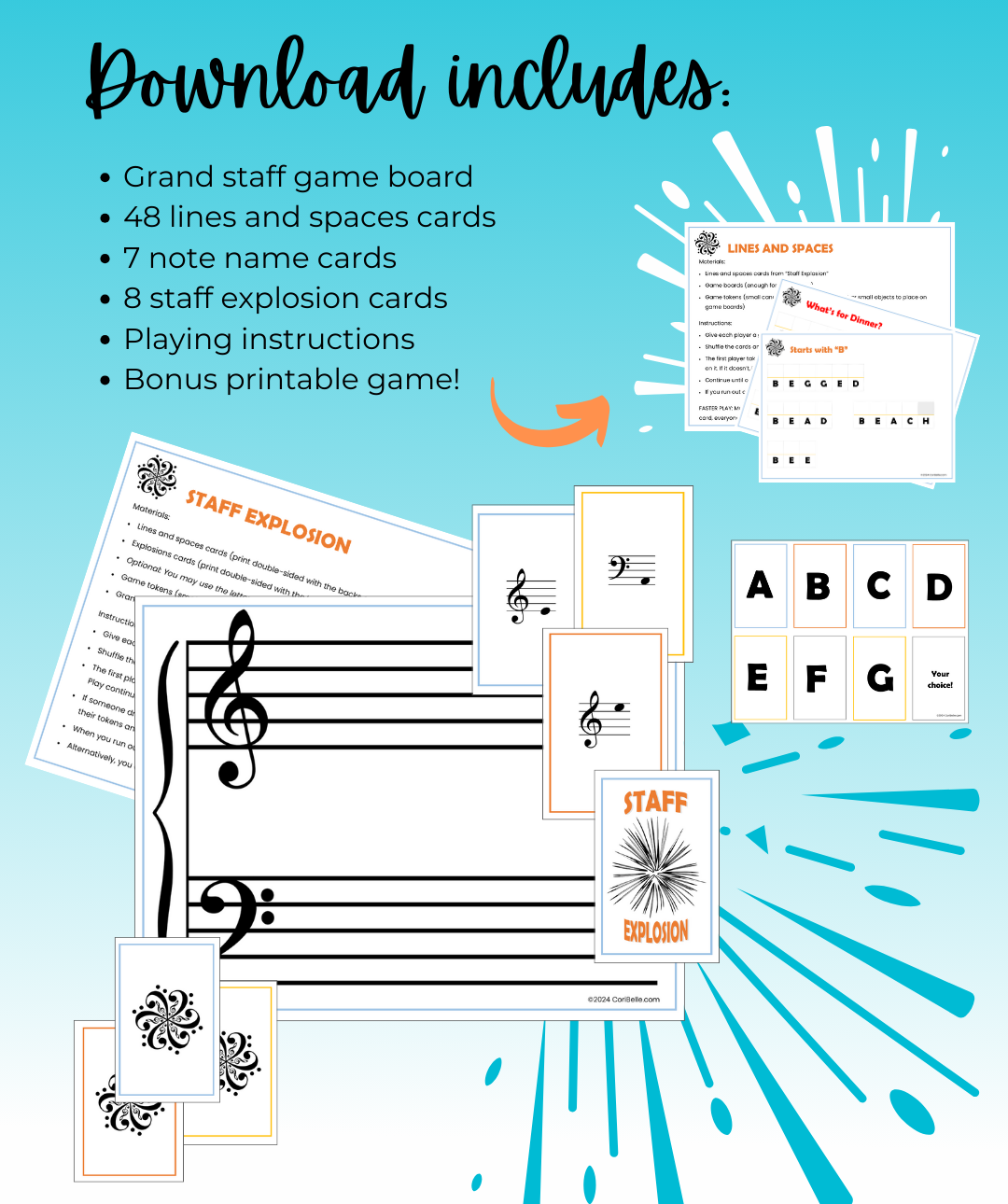
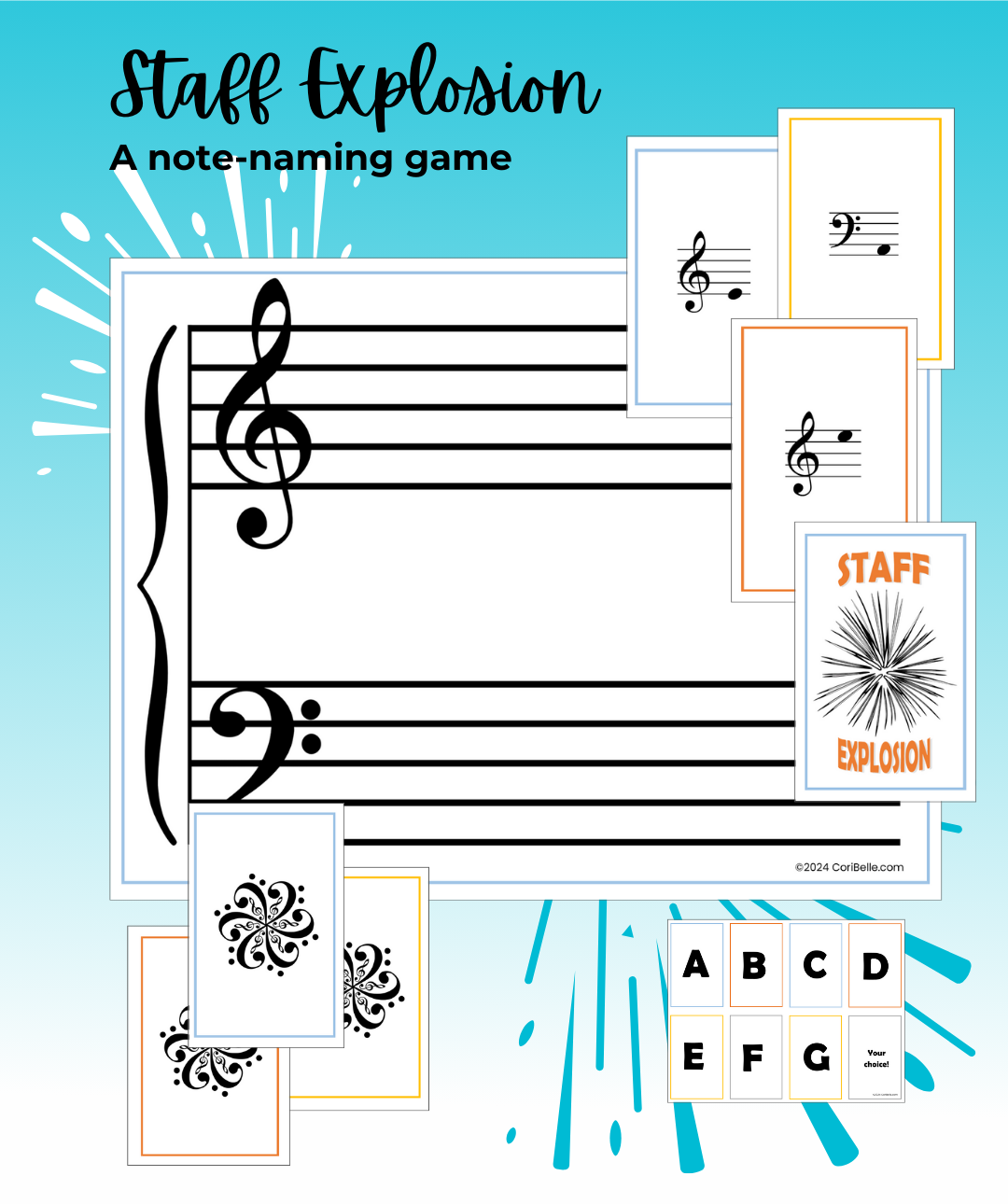
Staff Explosion is a brand new game that helps you teach and review note names in the order YOU choose. Do you like to start with landmark notes and their neighbors? Just print those cards! Do you like to teach FACE, All Cows Eat Grass, or other acronyms? Print the space or line notes that your student is working on and play with those cards. Ready for ledger lines? It’s got those, too!

beginner note name piano game on staff

I played this game in my Piano Party (a.k.a. Group Lesson) this month with mixed ages, both beginner and intermediate level students, and they loved it! We focused on just the bass clef notes this time, and by the end of the game the students were becoming more automatic in their recognition of note names!

This digital download comes with all kinds of goodies: 48 line and space note cards, 7 staff EXPLOSION cards, and even 7 letter name cards if you want to have students begin with “A, B, C, D, E, F, or G” and find the notes’ positions on the staff without any visual help!

I have also included a BONUS game called Lines and Spaces that uses the same cards, but different game boards. In Lines and Spaces, students have to complete words using the musical alphabet. They will think it great fun to spell words like “cabbage” and “beef”!

beginner note name piano game on staff

You will receive all materials for both games, including instructions and a hint for faster play with Lines and Spaces. The games come in PDF form as a digital download, and you can reproduce the materials as many times as you want for your personal studio use.

Here is the link to get yours! Let me know how you use it in your studio!

Happy music-making!

Keep up with my writing by subscribing to At Home with Classical Piano on Substack.