Viewing: Music - View all posts

Organizing Piano Student Binders 

This post first had its home on my substack, At Home with Classical Piano, which is where I write regularly now. Come join me there, or subscribe to my newsletter to stay in the loop and get posts delivered straight to your inbox!

It’s August…and that means school is just around the corner! And that means, it’s time to go school shopping again!

As you are getting ready to welcome piano students back into your studio this fall, I want to remind you of some resources in my shop that can help you get organized!

I give a one-inch, white, three-ring binder to each student. In the front of the binder, I slip Piano-opoly into the plastic sleeve. We use Piano-opoly to track progress - anything from completing a scale exercise correctly, to completing a song, to finishing a theory page. When students reach a square that says “prize,” they get to choose something from my prize box! Some of their favorites include:

Bouncy balls

Colorful music pens

Treble clef pencils

Puffy monster keychains

Mophead ballpoint pens

Brain teaser marble puzzles

Cute animal sticky notepads

Football fidget spinners

Fruity mechanical pencils

We keep track of their assignments on the Piano Tracker, where I write in detail what I want them to practice each week and students mark an X for each day of practice.

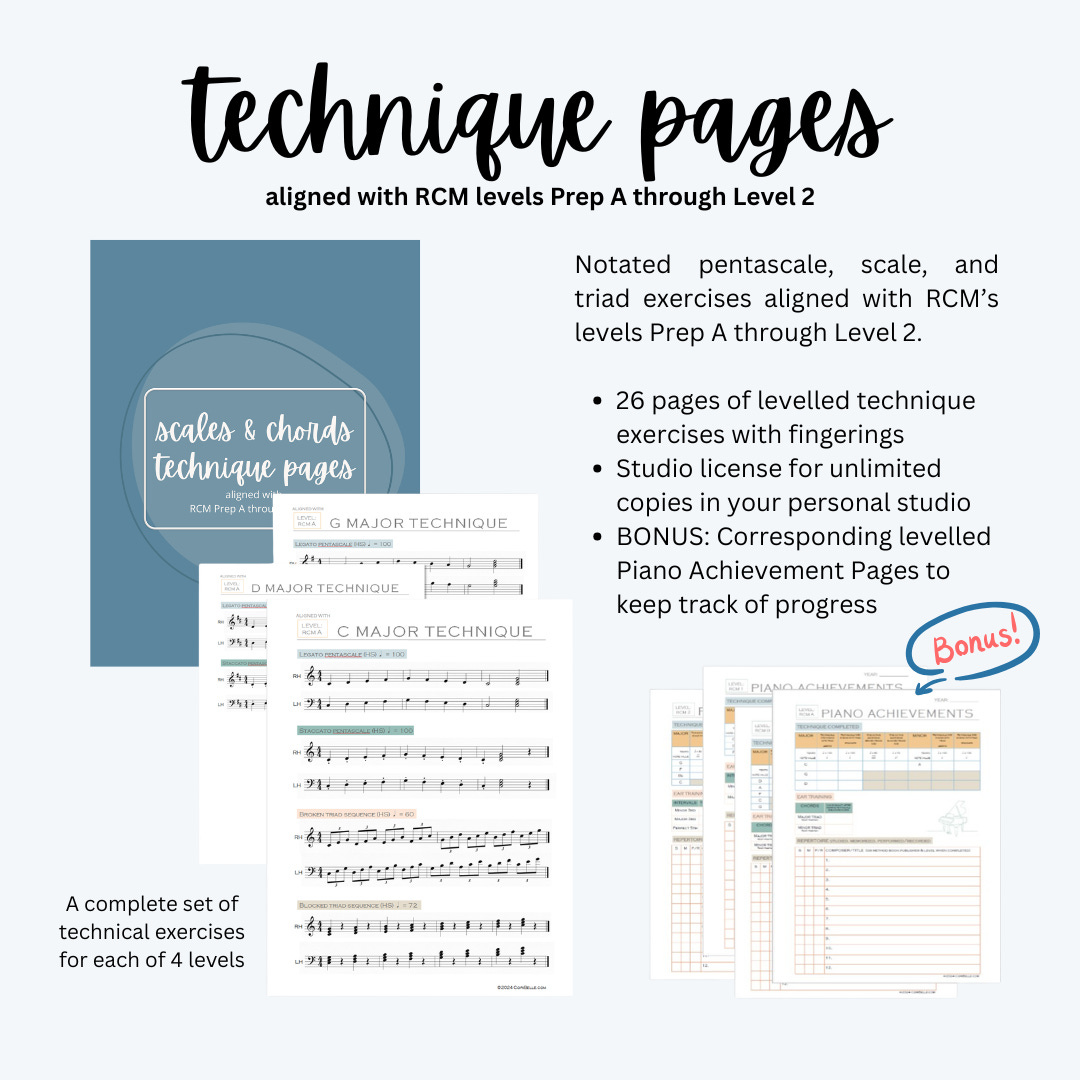
Students can see the progress they are making in technique and repertoire on their Piano Achievement page, which is aligned with the Royal Conservatory of Music levels. I use RCM’s technique requirements to guide students in a progressive study of scales and chords. I’m excited to announce that in addition to the achievement pages, I now offer corresponding technique pages for the first four levels (Prep A to Level 2) in my shop!

The technique pages make it easy for students to see exactly what they are to practice, with which fingering, in order to complete their technique requirements. If you already own the Piano Achievement pages, you’ll want to check these out!

I use colored tabs with labels to keep everything organized. I also keep my Studio Calendar and Studio Policy in plastic page protectors right after their Piano Tracker and before the tabs, for easy reference. Finally, I slip a Suggestions on How to Practice sheet in the back cover of the binder as a reminder for students.

You can watch a quick video of how everything is put together here.

The Piano Binders serve as a growing library of musical information for students as well as a place to house their assignments. The binders grow with the students and are a physical reminder of the hard work they put into practicing and music study, forming a portfolio of sorts that celebrates their achievements!

Many of the resources I mentioned above are free in my shop! Check them out!

Disclosure: As an Amazon Associate I earn from qualifying purchases. This means if you click on a link and make a purchase, I may receive a small commission. This commission comes at no additional cost to you and helps to support my music.

My Journey into Choral Accompanying 

This post first had its home on my substack, At Home with Classical Piano, which is where I write regularly now. Come join me there, or subscribe to my newsletter to stay in the loop and get posts delivered straight to your inbox!

I fell into choral accompanying unexpectedly. I was in high school at the time, having taken private piano lessons for a number of years. I was a good sight reader and loved playing duets with my dad. There was a certain boy who sang in the top auditioned choir at my high school, and when he suggested that I come play for the group, I jumped at the chance.

Those first rehearsals were rough! I learned to “give pitches,” playing first the bass, then tenor, alto, and soprano starting notes; to read different lines at the same time; and to follow the conductor’s gestures. I ended up playing for all four choirs for the next four years, and then was hired “for real” when I graduated and I continued to play for concerts while pursuing my undergraduate degree in a neighboring city.

From there, I went on to major in Piano Performance and spent as much of my “free” time as I could accompanying choirs, opera and musical theater productions, and voice lessons and recitals. After I graduated, I played for an accomplished 100-voice church choir that sang at notable local concert venues as well as travelled.

I also did a ten-year stint in Musical Theater, not just as a pit musician, but as a Music Director, and I learned a lot about timing and balance between singers and instrument in my time there.

Once I married and had three children, life in the music lane slowed a bit, but I kept up my “chops” by practicing when I could, and though I let go of the church choir position when home life got too busy, I started to miss it. After a few years, I started to research local community choirs. I ended up going to a summer “sing” of masterworks where I introduced myself to the accompanist and offered to substitute if she ever had a need. That led to a number of jobs with different choirs, and I continue to sub and play for choirs today!

If you have ever wondered if you have what it takes to play for a choir, here are some things I’ve learned along the way that might encourage you in your pursuit of choral accompanying!

What are some of the musical skills needed to succeed as a choral accompanist?

A competent pianist, able to play hymns and some Bach Preludes and Fugues, maybe a Haydn or Mozart sonata

A good sense of rhythm

Ability to learn music quickly

A willingness to serve the music by following the director and doing whatever it takes to bring out the best in him/her and the choir

How should pianists prepare for a choral rehearsal?

The following tips come from my Timesavers for Choral Accompanists

Prep your score (put it in a binder, break the binding/cut it off and have it spiral bound),

Listen to a recording of the music with your music in hand

Know the choir entrances (mark your score)

Practice the accompaniment – have a basic idea and be able to “get through” from the first rehearsal, but then practice and polish on your own time throughout the season. You should be able to play from beginning to end without stopping, in support of the choir; and then your priority is listening to the voice parts and being able to play them in different combinations *especially entrances*; then, as the choir becomes more confident in their parts, your job is to enhance the score musically by paying attention to the conductor’s phrasing, tempo changes, and dynamics; lastly, your accompaniment is the “icing” on the cake – never the most important; it comes at the end, after the foundations are well established. (And if you are playing an orchestral reduction, not to perform at the piano at all, you will try to add color and “sound” as much like the orchestral instruments as you can.)

Take good notes in rehearsal – keep a pad of sticky notes next to your binder so you can jot down notes when the director is addressing the choir, and return to them later when you can practice on your own at home

Plan for page turns! Practice them just as you practice your notes and rhythms.

If you would like to see how I prep a score in real time, check out this post and video.

How to work successfully with a conductor:

Make it your goal to make the conductor look good.

Don’t draw attention to the conductor’s mistakes (dropped beats, defining an Italian word wrong, bringing the choir in a whole measure early/late)

Always follow the conductor!

Anticipate what the conductor is going to say and be ready (the choir missed an entrance, prepare to go back)

Be professional. Rehearsals are not the time nor place to air grievances about the director or about the members of the choir.

Address any concerns privately.

Ask, “Can you clarify when you want me to start? Will you give me a preparatory beat, or an entire measure, before you want me to come in?” “What tempo do you prefer here?”

If a collaboration during rehearsal isn’t working, assume it is a misunderstanding on your part. Try to clear it up by asking questions of the conductor.

It is normal to feel overlooked sometimes, or not acknowledged (although a good director will express gratitude for your work) – that is part of the job, and if you have done your job well the choir will know their parts and sing musically whether or not you end up performing with them in the concert; however, if there is a clear issue of disrespect, where the director is continually pointing out mistakes publicly or disparaging you, and you have tried addressing it in private to no avail, it may be time to cut ties and find another choir.

What are some tips for practicing open score?

First of all: If you just need more sightreading practice, make sure you’re reading music 1-2 levels below your playing ability. Read a lot of easy music to get used to scanning the music quickly and then keeping your eyes moving ahead as you play.

You want to get really good at moving your hands around the keyboard without having to look at them. In rehearsal, you will be looking up at the director from time to time, and keeping him in your peripheral vision all of the time. You need most of your vision to be on the music. That leaves little to no time for looking at your hands. I like to think that if I were blind, I could still play familiar pieces on the piano because my ears and hands would guide me. Get used to how chords and octaves feel in the hands, and even how things feel when you’re switching hand positions (I would say jumps, but really what your hands should do at the piano is shift horizontally - not jump.)

Practice basic 4-part open score reading using Bach Chorales. I have two resources available to pianists to help you develop this skill:

A Choral Accompanist’s Guide to Open Score Reading (free guide)

The Well-Tempered Chorale Player, a selection of 15 Bach chorales written in varying key signatures, including both major and minor keys

Additionally, I have an Open Score Summer Intensive coming up this June 18-20, 2026, where I will teach not only how to work through the Bach chorales, but also share tips and tricks for learning music quickly and prioritizing what is most important.

Join me LIVE for a three‑day online intensive offering practical, hands‑on analysis and guided open‑score practice for choral accompanists and directors, helping you confidently play everything from Bach chorales to fugues.


Learn more and register here.

Just get started!

The best practice is on-the-job! Find a choir. Start by offering to substitute for a local group.

Practice reading a lot of music – it doesn’t have to be choral music; work on reading straight through without stopping and without looking at your hands. Glance up from time to time as if you are looking for cues from a conductor.

Practice your open score reading using Bach Chorales. Take my summer intensive and get a toolbox of strategies that will serve you well in rehearsal. The intensive includes three great workbooks that will give you practice with a variety of real-life choral scores long after the course is over.

Check out more choral piano resources on my website! You’ll find lots of information about what the job looks like, how to tackle different scores, and how you can prepare to be successful as a choral accompanist.

The choir world is a unique one, in that it is made up of a wide variety of people. Of course, serious professional singers may be a part of a choir, but more often than not, choirs are made up of schoolteachers, psychologists, judges, lawyers, doctors, chefs, waitresses, actors, music teachers, firefighters, and every other profession that you can think of. The members may have minored in music, or they may just miss singing in their church choir. They may be proficient sight readers, or they may be fantastic aural learners who struggle to read music notation. Usually, every member can point to one significant musical memory from their childhood that got them “hooked.” And the best choir directors can take this conglomerate of people, musical abilities, and experiences, and weave their voices into a beautiful, unified tapestry of sound that touches the souls of those who listen.

If you are not yet part of a choir, I encourage you to look around and see what is available in your area! Check out a few concerts. Offer to substitute for the accompanist. Get involved in your local community and you will be rewarded with new friendships with people who love music as much as you do!

Free Piano Sheet Music Resources 

This post first had its home on my substack, At Home with Classical Piano, which is where I write regularly now. Come join me there, or subscribe to my newsletter to stay in the loop and get posts delivered straight to your inbox!

Whether you are a piano teacher looking for music for your students, or a pianist looking for something new to study or play for an upcoming performance, there are a growing number of resources for free music on the Internet. Generally, “free” music falls under the auspices of what is in the public domain - music that is out of copyright because it meets your country’s requirements for X years past the publication date. However, there are some generous folks who have made their arrangements for beginner-intermediate students available for free download. Below are some of my favorite resources:

Chrissy Ricker has a number of pre-reading and elementary arrangements, as well as a few intermediate selections on her Free Stuff page. You’ll also find quite a few teaching resources on the page as well! (And if you would like to support her work financially, check out her music on PopMusicPlus which has fabulous arrangements of popular songs at every level.)

Gilbert DeBenedetti generously offers his arrangements of classical music and folk tunes, as well as some original tunes, on his site, G major theory. Browse by level.

Making Music Fun is a wonderful place to find music history resources. Did you know you can also download their free sheet music arrangements? Browse by classical, patriotic, Christian, jazz, Christmas, celtic, or nursery rhyme categories, or find by level (1-5).

And, of course, everyone should know of the Petrucci Music Library, where you can find a huge assortment of classical music in the public domain. Search by composer, nationality, time period, or instrument difficulty (Piano levels are ordered by the RCM levelling system, which generally starts at year 2-3 of piano study. No pre-reading music here.).

Choral pianists and conductors in search of choral-only music can check out the Choral Wiki, where you can search by voice part. If you’re looking to strengthen your open score sightreading skills, this could be a great resource for you.

Recently, I took advantage of several of these websites as I am preparing summer music for my students. I always like to have something a little out of our “norm” for the summer to keep things fun!

What is your go-to resource for sheet music? Do you take advantage of any of these free resources, pay for a monthly subscription for access, or write your own? Let me know in the comments.

The Music Learning Process: Zoom in, Zoom out, Repeat 

This post first had its home on my new substack, At Home with Classical Piano, which is where I write regularly now. Come join me there, or subscribe to my newsletter to stay in the loop and get posts delivered straight to your inbox!

I have slowly been making my way through Ravel’s Jeux d’eau. You may know the piece from the 2024 Olympics, when it was played in the opening ceremonies by pianist Alexandre Kantorow on a grand piano in pouring rain.

The picture makes me cringe – what an awful way to treat a beautiful instrument! However, the image of rain falling on the very instrument whose music simulates the movement of water is incredibly effective. My shock and awe at this sight drove me to explore the piece myself a few months later.

Let me start by saying that this is a difficult piece to learn! It is not straightforward like Mozart, where the notes fit neatly into their appointed beats and the melody is often clearly delineated in the right hand. Instead, Ravel seeks to create an impression of the different ways in which water moves.

In the Pacific Northwest, we are very familiar with water, specifically rain! Our rain comes in all shapes and sizes: fine mist that you barely see, steady unrelenting rain lasting weeks on end, quick torrential downpours, light pitter-patter drops that evolve into unexpected hailstorms. And then there are the rivers, lakes, ocean...and the waterfalls that barely drip with water in the summer’s heat but cascade violently during winter storms. Think of the millions of tiny water droplets that make up all these expressions of water and then imagine translating them into ink by giving a toddler a ballpoint pen with the instruction to “cover the paper with dots.” This is what the music looks like. How do you even make sense of it all?! My process with this, and all new pieces of music, tends to look like this:

1. Get an overview – listen with and without the score, muddle through a first reading

2. Analyze sections to identify patterns, work out chunks

3. Practice note by note, taking it apart hands separately, and write out the beats where necessary

Zoom in, zoom out and repeat. Even though I may start this process by going through steps one, two and three consecutively, I am constantly revisiting one or the other of the steps as I work towards mastery. I can never stay in one step exclusively or I hinder my own progress.

When presenting a new piece to a student for the first time, we make choices about how we will teach it: play it first for them; talk through it and analyze what is happening; or let them muddle through without any assistance. All three approaches accomplish different goals, and all three approaches are needed throughout the student’s time of study with us.

When we approach a new piece ourselves, we also make choices about how we will begin learning it. It is important to get an overview of it at some point (some may argue that this is an essential first step), perhaps by listening to a recording or muddling through a first reading. The latter is almost impossible to do in the Ravel, as parts are just not readable at first glance. Nonetheless, it is important to have an idea of how the piece is laid out and what Ravel is trying to communicate.

Analysis can get us a long way, as we study the piece first for an initial theme and begin noting sections that vary from, or repeat, the theme. We look for key changes, tempo changes, and register changes. We might even mark our music before we ever begin playing, identifying an ABA form or writing in names of notes or chords that are difficult to read (multiple ledger lines, for instance, or passages with double sharps!).

Practicing note by note, hands separately, slowly and methodically is also an important strategy, but it can be easy to “miss the forest for the trees.” In other words, we can get too focused in on the minutiae that we lose the whole arc of the piece if we stay in this mode too long.

Our practice must constantly be a process of zooming in and zooming out. Similarly, we need to teach our students to have a sense of the whole (This is usually not a problem, as students like to power through to the end, despite making numerous mistakes, or playing haltingly as they struggle to figure out notes in the midst of “getting through”) and to attend to small sections that need troubleshooting. This is why “play your piece three times a day” or “practice for 30 minutes a day” is not sufficient instruction. We need to spend time during the lesson demonstrating how to look at the big picture and identify sections (zooming out), and then in writing in fingering and practicing short bits in a focused and detailed manner (zooming in) so that our students learn effective ways to practice.

One fun way I like to “zoom out” when students are getting lost in practicing short bits is by taking them to the last four measures of a piece and teaching them the section. We then discuss working backwards as a practice strategy: now that they know the last four bars, they can learn the few bars before those and play to the end, feeling a sense of accomplishment!

If you play for a choir, you know that practicing choral music often demands a quick, efficient approach. This is where analysis is most beneficial to begin with, then muddling through the whole piece (identifying shortcuts), and working note by note only at crucial points. If you are interested in learning more about this approach, you can check out my Open Score reading workshop.

Practicing does not have to be a chore; it can be an enjoyable process of problem-solving and discovery when we learn to zoom in and zoom out, taking advantage of our time and energy by working hard on details in short, focused bursts, and then rewarding ourselves with the chance to play what we know and have already mastered – or listening to the music with our score and taking note of what another pianist does to make it musical.

Which of these three phases of music learning do you enjoy most? Do you tend to spend your time in [teaching or practicing] one phase more than the other two? I didn’t even speak to the topic of memorizing - is that a part of your learning process? Let me know in the comments!

This post was originally published on my Substack, where you can find my latest posts, Practice Sessions, and Mini Musikhaus recordings. To have content delivered straight to your inbox, sign up for my Newsletter.

My Grandpa's Composers Notebook 

This post first had its home on my new substack, At Home with Classical Piano, which is where I write regularly now. Come join me there, or subscribe to my newsletter to stay in the loop and get posts delivered straight to your inbox!

Several months ago I was visiting my parents at their house and my dad showed me a notebook that his dad, my grandpa, had put together years ago. It was a simple brown binder with no label or identifier on the cover, but upon opening it I found a certificate awarding a gold medal to my grandpa for its contents.

Before I go on, you have to know this about my grandpa: he was a collector. He collected books (hundreds? thousands?), rocks (and cut and polished them), iris (and belonged to a garden society), antique blue and white plates (which hung all over the kitchen walls), and stamps. He was most proud of his Queen Elizabeth stamps, but he collected all kinds. And he spent hours putting together his stamp collections into neat, orderly pages in binders.

It turns out that the brown binder that contained the gold medal certificate was another of these stamp collections! Inside was an exhibit of “Musical Themes from Great Composers” that he presented at the Second A.T.A. Topical Stamp Exhibition in 1953. Each page contains one or more stamps depicting a classical composer, a typed short bio of the composer, a brief description of the stamp’s origin, and a hand-written excerpt of a composition written by the composer.

It was this last bit that caught my dad’s attention. My grandpa was not a musician, and to our knowledge he had no formal musical training; yet the copied music is meticulously rendered in black ink with all the proper formatting and no mistakes. The attention to detail is astonishing.

I don’t know if there is any “use” for these pages any more, but as a part of my family history - and the fact that both my dad and myself became accomplished pianists - the binder is a wonderful treasure to us.

Here are a few of the pages: 

Do you have similar musical artifacts in your family’s history? I’d love to hear about them!

Best Gifts for Classical Pianists: A 2025 Gift Guide for Pianists, Music Teachers, and Music Students 

Best gifts for pianists

From treble clef paperclips and music-themed ornaments to beautifully illustrated children’s books and resource books to use in your teaching, to a magnetic iPhone tripod and a Bluetooth pedal page turner that will make your life a little easier, you are sure to find something to love!

Check out my Substack for 15 of my favorite books, gadgets, and teaching tools for pianists - including gift ideas for piano students!

The Secret to Growing as a Musician: Listen to Yourself 

My formal training in piano stopped shortly after I completed my undergrad. I took a few graduate level courses at an international music school, but never ended up pursuing my master's degree. Yet, I have worked hard in the years since to maintain my skills and even to improve both technically and artistically. There were opportunities that presented themselves to me - like being offered the pianist position at my church and taking one-off lessons with a friend's teacher - and others that I intentionally pursued - like getting into the musical theater world and finding a community choir. But the thing that has grown me the most is something I never would have predicted: listening to myself play.

In 2018, my children were squarely in the grammar school phase and it occurred to me that I should try making a CD during the hours in which they were attending school. I'd recorded one before, with the help of friends who owned a small production studio, and we had recorded live tracks at a beautiful music center in the mountains. (Listen to that album here.) I'd also been a part of several live choral recording projects, so I was aware of the pressure to perform and the hyper-consciousness one enters when in such a situation. But I didn't want to record in a studio on someone else's instrument or even on a single day. My vision was to record on my own piano, in my own living room, over the course of weeks, taking a leisurely pace and listening to takes in between recording sessions.

Doesn't that sound fantastic? The reality was so much different (read more about that here). Between the piano developing weird clicks, airplanes roaring overhead, and the neighbors mowing their lawns, it was quite the experience! I learned a lot about self-recording and producing. But I learned a whole lot about myself as a pianist, too.

Listening to recordings of yourself is eye-opening and not for the faint of heart! The process of recording and my desire to share my music turned the heat up even more, and so for several months I scrutinized my playing ruthlessly. Everything was subjected to criticism, and I found myself asking, “What makes my playing different? What is my signature sound? How might I convey my personality and feelings about this music solely through sound? Who am I as an artist? What differentiates my sound from the thousands of existing recordings?”

The exercise was immensely stretching and so good for my playing. I became more concerned about accuracy, but also more intent on producing a beautiful tone. I wanted listeners to hear the shimmery top of my piano and feel like they were in my living room listening to one of my intimate house concerts.

In the end, the recording was far from perfect, and there are definitely things I would do differently a second time around. But it was mine. And I had emerged a better musician and pianist because of it. (Listen to the recording here.)

Why do I share all of this with you? Because too often we sit down and play the piano for the thrill of playing and we forget to listen to what we're producing. The physicality of playing is so absorbing that we forget to make music. Either we are facing technical challenges, or fingering difficulties, or odd leaps, or we're taking pride in how fast our fingers can fly and what kind of physical gymnastics we're capable of at the keyboard. It is so easy to forget about the sound. Even worse, when we are faced with a new piece of music, especially in a collaborative situation where we are playing for a choir, we get so hyper focused on playing the correct notes that we forget to breathe and sing the lines.

We have the incredible privilege of being musicians. Our goal is to make music. And the way we get there is to start listening.

In your playing this week, whether on your own or with a choir, I encourage you to listen intently to the sound you are making. Challenge yourself to be musical every time you sit down, even during a first reading. You will find that it makes the process so much more enjoyable, and your playing will be better because of it!

Keep up with my writing by subscribing to At Home with Classical Piano on Substack.

Teaching Piano Students How to Listen 

"Tell me about what you just played. Did you include the dynamics?"

"I don't know."

Have you had a similar exchange in your studio? This is all too common with my students. They play for me; I make some comments, praising them for what they did well and addressing one or two things that need work; and then they try again. Then they look to me for my approval. 

But I don't want them to always look to me; I want them to notice if they have accomplished what they set out to do. I want them to listen.

My goal in piano teaching is to create independent learners. I want my students to play well technically and express themselves musically, but I also want them to eventually be able to learn music on their own. In order to do this, I will need to spend a number of years with them building up their technical, musical, and reading skills. I also need to teach them to listen.

How is this accomplished?

When students first come to us, their movements are often crude and unrefined, and they are so intent on pushing the keys that they forget to listen. But that doesn't mean they can't be taught! This is why we begin teaching them how to count, drawing their attention to when notes move higher or lower - aurally and visually and kinesthetically. It is why we teach dynamics and the difference between staccato and legato playing. As they grow, we talk about phrasing and making the music sound like a conversation, or a story. We introduce concepts like rubato.

We  need to teach students to pay attention to what they are doing at the piano.

One thing we can do to help our students begin listening to themselves is to have them play through a piece once, working out movements and fingerings, and then ask them to play it a second time with dynamics (or articulation, or whatever it is you want them to attend to). The physical won't always be isolated in practice, but it is often this way when we approach a new piece.

We can't toss out body mechanics. Students still need to move their fingers, control the force of their arm weight, and so on. And so much of their work in learning to play the piano is focused on controlling their movements. But as they work out technical difficulties, they ought also attend to the sound.

I remember learning in this fashion for many years - practicing to master playing the instrument with each new piece I was given - and then my teacher would start asking me to "add expression."

As pianists, our goal should always be to play musically. The movements our bodies make are just a means to an end. If we, or our students, can play all of the correct notes but lack any shaping of the phrase, articulation, dynamics, or rubato, what are we doing?

I like to tell my students that the piano is a musical instrument, not a computer! 

Pressing the right keys doesn't make music. Shaping the sound with the way we move, breathing between phrases, listening to how notes rise and fall, and making adjustments to the tempo and dynamics does!

Here are some things we can do to train our students to listen so that they can become musicians at the keyboard, not merely piano "players":

1. Demonstrate what we want them to do. Have the student sit in your "teacher chair" while you play. Talk about what you are doing. Then, have the student try to imitate your playing. Praise their efforts. Discuss how they can manipulate their movements to achieve a certain sound.

2. Record the student and play it back to them. Tell them what to listen for. When students are physically removed from making the sound, they can listen more intently.

3. Play recordings of other pianists, either audio or video, for your students and encourage them to listen for a specific thing each time.

As students mature and become more self-aware (and better listeners), they will develop the ability to play more musically. Their desire to make music will grow, and they will begin self-correcting their mistakes and adjusting their movements to create the kind of sound they want to hear. 

As you welcome students to lessons this week, consider how you can encourage them to be better listeners as they play!

Keep up with my writing by subscribing to At Home with Classical Piano on Substack.

Why You Should Play Duets with Your Piano Students 

  1. Duets are fun! As one of my young beginners said once, “It sounds better when we play together.” A duet can help the simplest beginning song sound like “real music,” and even our youngest students need to experience making beautiful music!  I love mixing things up once in awhile and starting a lesson by playing a duet with a student. 
  2.  
  3. Here are some reasons why playing duets with our students can be really beneficial:
  • Duets are one way to teach steady beat. We can clap, count, march, and tap until we are blue in the face (and sometimes we do!), and still we have students who need more practice with this concept. Duets are one tool we can use to help keep the beat as our students play, and as we play together more often, the experience can help our students start to internalize a steady pulse.
  • Duets strengthen the teacher-student bond. We all want to connect with our students, to form a relationship of trust and respect so that the teaching-learning exchange is profitable and enjoyable. When we sit beside our students and play duets, we create a shared experience where for a moment we are musicians together.
  • Duets are a great way to practice sightreading. Some students will naturally read every piece of music they can get their hands on. Others need a little encouragement. Find pieces that are a level or two below the student’s playing level, and read them together as a duet at a moderate tempo. Help the student be successful by previewing the score together, discussing where there might be unexpected rhythms, leaps, or key changes. Then, set the tempo and play!

If you are using a method book series like Faber and Faber, Alfred, or Bastien, you will find teacher duets written in the lesson book for many of the student’s songs. These are great to play with beginners after the student has mastered playing their part.

For students who have been taking lessons for a few years, Margaret Goldston has some fun elementary level duets that are great for sightreading. Try “Duets for Bear Lovers,” “Duets for Cat Lovers,” or “Duets for Dog Lovers.” (I just learned that she also has three books of “Duets for Christmas Lovers!”) Goldston’s books feature primo and secondo parts of equal difficulty, and it can be fun to take turns playing each part with your students.

You might also try Helen Marlais’ “In Recital Series” of duet books published by Alfred Music. 

A fun book for intermediate and advanced students is The Rodgers and Hammerstein Piano Duet Book arranged by Walter Pels and David Carr Glover. (You may have to find this one as a used copy!) Depending on your student’s sightreading ability, you may prefer to assign pieces in this book for the student to study at home before playing together.

At the advanced level, students may enjoy Faure’s Dolly Suite, Dvorzak’s Slavic Dances, Compton’s C.S. (Chopsticks) Theme and Variations, or any of a number of wonderful pieces for four hands.

What are some of your favorite duets to play with students? Let me know in the comments!

Keep up with my writing by subscribing to At Home with Classical Piano on Substack.

The 3 Stages of Piano Teaching: From Survival to Student-Centered Success 

whirling leaves

I was teaching out of one of the Faber Piano Adventure books the other day and came across “Whirling Leaves,” which I have taught many times before. Something about seeing it again reminded me of my first time trying to teach it to a student, and the ensuing struggles to master the rhythm. 

The piece is not that difficult: a left-hand accompaniment pattern that repeats, beginning by itself and then gradually bringing in a simple right-hand melody over the top. But inevitably kids get the counting wrong the first time they read it, and by doing so they establish a [bad] habit of playing the incorrect rhythm every single time

An experienced teacher knows this about this particular piece and will “frontload” the student with information to make the first reading a success: Play the piece for the student so he can learn how it is supposed to sound; count and clap the rhythm together; have the student write in the beats; practice playing just the left hand and counting aloud until the rhythm is mastered. But a beginning teacher does not always anticipate what challenges a particular curriculum/piece of music might present, especially to a student who lacks the background knowledge needed to be successful. Further, a beginning teacher often has limited strategies for addressing challenges as they come up.

Are you aware of the different stages of teaching we go through, the normal path of growth and development for a teacher? When I went through my teacher training to become a certified public-school teacher, I learned that there are three stages every new teacher goes through (whether new to the profession or new to a particular grade level or curriculum):

  1. Teaching with a focus on me – How do I get through the day? What am I supposed to be doing? What are others thinking about me?
  2. Teaching with a focus on the curriculum – What am I teaching? How can I adequately explain what needs to be taught?
  3. Teaching with a focus on the child – What does the child need? Is my instruction reaching him? What does she understand, and where is she still struggling? How can I adapt to meet his learning needs?

Each stage can take a year or so to move through, through no fault of the teacher. It is just how things tend to work! 

Which of the above stages do you most identify with currently? 

If you’re at #1: Be encouraged, knowing that all of us start at this stage! Rather than feeling self-conscious about your teaching, be assured that you have something to offer. Be willing to learn from your mistakes. As you approach each lesson, review what the student already knows and build on that foundation. If things aren’t working, don’t be afraid to stay with a piece for a few weeks, or even to review old pieces to solidify concepts. Try different things. Reach out to a colleague if you’re not sure what to try. Know that as time goes on, you will refine your teaching and hone your skillset.

If you’re at #2: You’re starting to think more strategically about content. Lean into this time! Research best practices in teaching. Take a pedagogy class, listen to podcasts, follow a blogger. Choose a method and stick with it; learn its strengths and weaknesses and supplement where you need to. Although not strictly related to pedagogy, you might find some helpful resources in my article on Professional Development for Pianists.

If you are at #3: You’re comfortable with your teaching materials (method, anthologies, technique) and ready to really consider how to address specific needs of students. Be intentional about finding music that both highlights their strengths and challenges them to grow. At least once a year, reflect on where each student has been and where you would like them to go. Check in with parents to give and receive feedback on lessons and practice. Experiment with different ways of explaining the same concept. Join a good piano teacher group on Facebook and participate in the discussions, use the search function within the group to explore specific topics, and be open to learning new ways to teach effectively. Some well-moderated groups include Professional Piano Teachers, The Art of Piano Pedagogy, and Piano Teacher Central.

Wherever you are at in your teaching journey, I hope you are enjoying the process of discovery and growth – both in your students and in yourself! I don’t think any of us ever “arrive,” but we can definitely refine our skillset and become better communicators and educators if we are willing to commit to a lifetime of learning!

I am offering a mini-course this fall on When the Method Book is Not Enough, all about evaluating the curriculum you're using and how it fits your particular students' needs. We will discuss ways to supplement your current method books or transition out of them altogether. My goal is to give you a better understanding of what method books can and cannot accomplish as well as an assortment of tools and resources to curate the best books for motivating and engaging your students. If this topic interests you, click here!

Keep up with my writing by subscribing to At Home with Classical Piano on Substack.

What an Intermediate Piano Lesson Looks Like in My Studio 

The Intermediate stage of piano lessons is quite variable. It can range from 3-6 years, or even more, of study, and spans a wide range of repertoire. For my purposes here, I will define it as the time beginning when a piano student has received 3-4 years of instruction, can comfortably sightread simple music hands together in C, F, G, and D major (and their relative minors), has an understanding of major intervals and primary triads, and has developed some independence in practicing at home, and extending to the time when the student has developed proficiency in a wide variety of literature and is ready to move on to advanced technical and interpretive challenges. Generally, the intermediate student has some fluency at the keyboard and is ready to begin working on more difficult music and exploring musical expression and interpretation rather than “just doing what the teacher says.”

I offer 45-minute lessons to Intermediate students, as 30 minutes is just not enough time to dive deeper into the music they are learning. My 45-minute lessons are generally structured in this way:

  • Technique (scales and chords from the Royal Conservatory of Music's program)
  • Repertoire - old and new, in various stages of progress
  • Theory - used to be RCM's resources, but this year I am loving Mark Sarnecki's Elementary Music Theory and Essential Music Theory books!

I often ask students what they want to start with. I like to give them the option of “showing off” what they have learned in a particular piece or jumping to something they really want help on. Other times, I will pull out a simple duet book and we will start a lesson by sightreading a duet or two together (SO FUN! And such good practice for these kiddos!) There are also times when I really want to make sure we address technique or theory, or a particular piece of music, and I will choose. But I like giving students autonomy over “what we do first” whenever I can.

Technique is so important for these students. I often get intermediate students who are transfers, and what is most often lacking is solid technique. So we discuss posture at the piano, using our whole bodies to play (not just the fingers!), proper hand position, and the importance of playing without tension. We address a lot of technique within the music itself, like wrist rotation and accomplishing “jumps” side-to-side rather than up-down, but I also want my students to be very familiar with major and minor scales and chords in every key. We talk about how learning the correct fingering for scales and chords in inversions and arpeggios gives us tools that will help our playing, because then when we see scale passages or arpeggios in a piece of music, our fingers already know where to go! Our students need to recognize these patterns in their music as they grow in their reading skills.

Repertoire is so varied in this group, but I do like having one book that forms our “core." For students who are interested in classical music, I'll use one of the Faber Piano Literature anthologies. (I also like the RCM Etude books as part of our “core.") For students who are interested in playing in a worship band at their church, I'll use Donna Gielow McFarland's Worship at the Keys, as well as music that their church is playing. The rest of their repertoire I choose based on their interests - a book on sonatinas, a fake book with lead sheets, Celtic music, hymn arrangements, musical theater anthologies, music by a favorite composer, and so forth. 

Students are often working on 3-5 pieces at a time. I like to assign one piece that can be learned and mastered in a week, another few that will take a little longer, and then a “stretch” piece. Additionally, if the student needs to have a lot of “quick wins,” I will choose pattern-based music like Juan Cabeza's Diversions. It is important that not everything is hard. Our students, just like us, need to have music that they can play easily for enjoyment as well as music that takes focus and discipline to master. Finding balance between the two is the sweet spot and the “secret” to motivating students to practice.

Beyond learning correct notes and rhythms, we also work a lot on expression - paying attention to the form of a piece, differentiating between repeated material, attending to articulation, breathing between phrases, developing beautiful singing lines, and so on. Sometimes we will work together to create a “story” narrative of a piece, to get the student thinking in terms of beginning, middle, end, or tension-resolution. I want my students to not only learn how to play the instrument, but also to learn to listen to themselves and really begin to “sing” at the keyboard. These things take time to develop, and usually begin by strict imitation of what I'm doing. Gradually, students begin to take risks and develop some ownership of their pieces. This is when lessons get really fun! 

Theory is another important component to lessons and the students' theory books give us an opportunity to discuss why music is notated the way it is. Music is an aural art, but to pass it on to a wide audience it needs to be written down. For a full comprehension of how music works and why, our students need theory and performance practice.

The intermediate stage of lessons can quickly become really fun or really hard. I find that with good music selection, giving students choices, and making sure they are able to have a “win” every week (a scale learned, an easy piece mastered, or a fun time playing a duet with me), students stay engaged and enjoy lessons. (And hopefully they enjoy some of their practice time at home, too!)

Let me know what you love about your intermediate lessons! What is still hard? Let me know in the comments.

Keep up with my writing by subscribing to At Home with Classical Piano on Substack.

Working with the Choir Director: A Choral Accompanist’s Guide to Professional Collaboration 

Working as a choral accompanist can be very rewarding. There is nothing like supporting a group of singers from behind the keyboard: helping them to learn their parts, encouraging their progress, and then enjoying the fruits of our labor as we accompany them in concert. Carrying out a director's vision, anticipating what he/she is going to do before he/she does it, and contributing to the overall excellence and beauty of the music can be incredibly fulfilling. However, there are times when we work with directors and our personalities don't mesh well, communication is difficult, or maybe we are the better musician. Rather than cut ties and run, it can be worthwhile to try and make things work, especially if we are invested in supporting the choir members. Here are some ideas for how to remain professional and keep the peace while working in a less-than-ideal situation:

Make it your goal to make the conductor look good.
o    Don’t draw attention to the conductor’s mistakes (dropped beats, defining an Italian word wrong, bringing the choir in a whole measure early/late)
o    Always follow the conductor!
o    Anticipate what the conductor is going to say and be ready (the choir missed an entrance, prepare to go back)
o    Be professional. Rehearsals are not the time nor place to air grievances about the director or about the members of the choir.

Address any concerns privately. 
o    Ask, “Can you clarify when you want me to start? Will you give me a preparatory beat, or an entire measure, before you want me to come in?” “What tempo do you prefer here?” 
o    If a collaboration during rehearsal isn’t working, assume it is a misunderstanding on your part. Try to clear it up by asking questions of the conductor.
o    It is normal to feel overlooked sometimes, or not acknowledged (although a good director will express gratitude for your work) – that is part of the job, and if you have done your job well the choir will know their parts and sing musically whether or not you end up performing with them in the concert and whether or not you are publicly acknowledged. However, if there is a clear issue of disrespect, where the director is continually pointing out mistakes publicly or disparaging you, and you have tried addressing it in private to no avail, it may be time to cut ties and find another choir.

Being a choral accompanist means contributing to the success of the choir, and this requires professionalism and respect in our interactions with directors. Even in less-than-ideal circumstances, our professionalism and artistry can make a lasting impact. By choosing grace over grievance and collaboration over conflict, we not only support the choir’s success but also have the opportunity to grow as musicians and colleagues.

Keep up with my writing by subscribing to At Home with Classical Piano on Substack.

How to Write a Good Piano Studio Policy 

How many times have you set your piano lesson schedule and explained how missed lessons work, only to have a parent come to you asking for something other than what you offer? For example, perhaps you teach from 3-7pm Monday-Thursday, but a parent asks if you can teach at 7:30pm…or if you can teach their child on Fridays? 

Does this give you pause? Do you hesitate in a scenario like this and end up giving in because you could use the money or you want others to see you as gracious and flexible? I have been there! But it is not a good place to be. Going outside of the parameters you have set for your piano studio can cause regret and end up causing resentment. There’s a better way!

Having a good studio policy in place can prevent many such discussions - and more - but you must be clear about what you offer and then stick to your policy

What is a studio policy?

Simply, a studio policy is a document that states what taking piano lessons with you looks like, from which days and hours you teach to how you handle missed lessons to how you handle payment. It also gives information about your expectations for practice and lesson attendance. And it explains what you teach and why you structure the lessons the way you do.

How do I create a studio policy?

You can start by writing a 1–2 page document stating what you offer and what your expectations are. A good studio policy will include the following elements:

  1. Your philosophy of teaching (how and why you teach)
  2. Who you teach 
  3. When and where you teach
  4. What kinds of lessons you offer
  5. How you accept payment
  6. How you handle missed lessons
  7. What your expectations for students (and parents) are during lessons and in at-home practice

I introduce my studio policy to everyone who interviews to be part of my studio. After the interview, a printed copy goes home with the parent along with a copy of my studio calendar and a contract for payment. In order to secure lessons with me, the contract must come back signed by both parent and student, indicating that they agree to my policy and terms for payment. (An additional printed copy of the policy and studio calendar go in each student’s binder. Learn more about how I use binders here!)

Having a clear policy in place shows parents that you are a professional and have parameters around how you run your business. After the initial expectations are stated, the policy becomes a tool that you can refer back to when questions come up concerning payment, missed lessons, practicing, and so forth. When you are asked to make an exception, you are free to be flexible, but you are also free to gently but firmly refer back to the policy with “No, I’m not able to do such-and-such; instead, this is what I offer.” 

Having a good policy in place and the determination to hold fast to the expectations you set for the studio can resolve many potential conflicts and help you focus your time and energy on teaching!

What are some boundaries you have set in your studio policy that have been helpful in your studio? Let me know in the comments!

Keep up with my writing by subscribing to At Home with Classical Piano on Substack.

How to Practice the Piano as an Adult 

How to practice the piano as an adult

Commit to doing one thing better.

That's it: one thing! What is the one thing you want to have accomplished today at the piano?

We can easily over-complicate things as adults. We think we need to come up with a warm-up routine, or read through a whole piece from start to finish before we start practicing, or…[fill in the blank]. But often we just need to commit to doing one thing better.

I must admit: my summer was not filled with much practice time at all! Instead, I spent time with my three teenaged daughters, taught piano lessons, worked on some product development, and spent time evaluating and honing systems in my music studio. So when I returned to the piano last week, I had some decisions to make! What music do I want to study this season? What performance goal am I working towards? Which piece will I work on first?

I picked up some music that has been lying dormant for a few months and returned to it: Liszt's Jeux D'eau, Debussy's Sunken Cathedral, various Chopin pieces, a Bach suite, a new piece by Heino Kaski… And as I've been reading through, I've started noting what needs work! Some music needs harmonic analysis, others need slow work and decision-making about fingerings; another piece needs to be committed to memory because there are too many awkward jumps; still another piece needs technical work. 

I pulled out my practice journal again and wrote down what pieces I'm working on this year, and then made a short list of what I need to do next. I love doing this because it gives me a focus. The next time I return to the piano, I'll know exactly what to start on. Whether I have ten minutes or an hour, I will be able to grab a piece, start working, and accomplish something because I've made a note of what specifically needs work.

Whether you are working on music for your personal growth, a performance, or just to keep up with your students, try keeping track in a notebook or on a piece of paper what you accomplish each day and what you want to work on next. Be specific. Write in measure numbers. Tell yourself what needs work. Be your own teacher. 

Little gains add up to big wins. Do one thing better today!

For more thoughts on practicing, see:

Using a Practice Journal for More Effective Practicing

Always Be Prepared: Three Songs at the Ready

Practicing in Sections

Backwards Practice

How I Memorize a Piece of Music

How to Prepare for Accompanying an Instrumental Sonata (or Concerto) Quickly

Keep up with my writing by subscribing to At Home with Classical Piano on Substack.

Introducing...The Scarlatti Composer Kit! 

Scarlatti composer kit

I had so much fun putting this Composer Kit together! The life of Domenico Scarlatti is fascinating - his encounters with royalty, his different stylistic periods, his infamous duel with George Frederick Handel in Rome…and his experiments at the keyboard offer much fodder for discussion and exploration in student compositions!

Scarlatti wrote 555 keyboard sonatas, although not in the sonata-allegro form that we are familiar with in the Classical era. His sonatas are often in two parts, and include techniques like imitation, counterpoint, fast repeated notes, and crossing hands. He also plays with Baroque dance form and fiery dance rhythms from Spain, definitely a “Renaissance man”!

Students will love engaging in a Tic-Tac-Toe duel of organs and harpsichords, creating copycat fugues in a fun group game at the piano, and trying their hand at composition in the style of Scarlatti.

The Scarlatti Kit, like all of the Composer Kits in my shop, contains a 1-page biography (one sheet at the intermediate level, and one for younger readers), two games suitable for playing student-teacher or in a group setting, a playlist with suggestions of what to listen for, and a composition activity (one for beginners and one for intermediates).

I use these kits in group lessons once a quarter, but the materials are also great for composer study within private lessons, in homeschool co-op music classes, or as an independent take-home activity.

Find the Scarlatti kit here!

For more Composer Kits and a free resource, check out this link!

My Grandpa's Composers Notebook 


Several months ago I was visiting my parents at their house and my dad showed me a notebook that his dad, my grandpa, had put together years ago. It was a simple brown binder with no label or identifier on the cover, but upon opening it I found a certificate awarding a gold medal to my grandpa for its contents.

Before I go on, you have to know this about my grandpa: he was a collector. He collected books (hundreds? thousands?), rocks (and cut and polished them), iris (and belonged to a garden society), antique blue and white plates (which hung all over the kitchen walls), and stamps. He was most proud of his Queen Elizabeth stamps, but he collected all kinds. And he spent hours putting together his stamp collections into neat, orderly pages in binders.

It turns out that the brown binder that contained the gold medal certificate was another of these stamp collections! Inside was an exhibit of “Musical Themes from Great Composers” that he presented at the Second A.T.A. Topical Stamp Exhibition in 1953. Each page contains one or more stamps depicting a classical composer, a typed short bio of the composer, a brief description of the stamp's origin, and a hand-written excerpt of a composition written by the composer.

It was this last bit that caught my dad's attention. My grandpa was not a musician, and to our knowledge he had no formal musical training; yet the copied music is meticulously rendered in black ink with all the proper formatting and no mistakes. The attention to detail is astonishing.

I don't know if there is any “use” for these pages any more, but as a part of my family history - and the fact that both my dad and myself became accomplished pianists - the binder is a wonderful treasure to us.

Here are a few of the pages:

Keep up with my writing by subscribing to At Home with Classical Piano on Substack.

Getting Ready for Choir 

Are you ready for choir? My choir starts up next week after having taken 3 months off for the summer break, and I can't wait to see everyone and dive into some new music! As a choral accompanist, I don't need to worry about getting my voice back in shape, but I do need to get back to the piano in earnest and “warm up my chops” that have gotten a bit lazy over the summer!

Here are a few things I'm doing to get ready for choir:

  1. Clean out my tote bag. I was given this amazing, sturdy burlap “Chopin” bag years ago, and I use it for toting music to all my collaborative piano gigs.

2. Clean out my black piano binder, add a mechanical pencil and post-it-notes.

3. Commit to sitting at the piano 10 minutes a day. Since I don't have choir music yet, my goal is simply to get some music back into my fingers, focus my attention on reading, and enjoy returning to practicing music that has been on my shelf for a little while: Ravel's Jeux d'eau, Debussy's Sunken Cathedral, a Bach suite (Bach is SO good for reading multiple voices and practicing efficient fingering)…

Once you receive your music for the new season, you might want to check out my free guide, Timesavers for Choral Accompanists

Also, commit to arriving a few minutes early to each rehearsal. It can be tempting to show up right on time, but by showing up 10 minutes early, you build in time for unexpected traffic, give yourself the opportunity to connect with a choir member or two before rehearsal, and maybe even get a chance to quickly scan any new music the director hands you. Plus, arriving early helps you establish yourself as a leader, providing an example for others to follow and contributing to the overall professionalism of the group.

As always, you can find more resources specifically designed for choral accompanists at CoriBelle.com/Choral-Piano

Looking for something more? Feel free to shoot me an email!

Keep up with my writing by subscribing to At Home with Classical Piano on Substack.

The Role of a Choral Accompanist 

Picture yourself sitting at the piano. You listen to the choir, play their parts as they sing, and follow the conductor. As you scan the score, you suddenly notice an upcoming tenor entrance that is sure to go awry. You make a quick decision to pull back on the other voice parts, leave out the soprano melody, and play the tenor entrance clearly and on time. The tenors nail the phrase, the conductor stops to address a diction issue with the choir, and you all return to the beginning to review the section again. This time, you play all parts equally and listen to see if the tenors can get their entrance without your help. They can. You sit back, proud of the tenors, and full of the satisfaction that comes from preventing a train wreck. You are the Invisible Conductor.

Has this happened to you? 

A good choral accompanist makes many decisions like this “behind the scenes,” many times without the conscious knowledge of the director or the choir. The accompanist is the “invisible” conductor, contributing to the success of the choir technically (playing the right notes), musically (playing with expression), and artistically (working in tandem with the director to accomplish his or her artistic vision for the music). The accompanist functions as a co-leader with the director in bringing out the full potential of a choir.

Why do I mention leadership in what is obviously a subordinate role? Because a good choral accompanist is a leader, leading the choir (and sometimes the director) by example. The accompanist is confident in her skillset, knowledgeable about how best to support choral singers, and willing to submit (to the director) or lead (in partnership with the director, or in the director’s absence) as the role requires.

The choral accompanist holds two main roles: that of rehearsal accompanist, which requires one to play all of the vocal parts during rehearsal as well as learn the accompaniment, and which may include leading vocal warm-ups, rehearsing singers in sectionals, and substituting for the conductor in his or her absence; and that of performance accompanist, often the sole musical support for the choir, but sometimes called upon to be part of a chamber ensemble, orchestra, or to provide accompaniment for guest soloists. The two roles vacillate between leadership and support, requiring the accompanist to lead and to follow as the situation requires.

At the time of this writing, I have been accompanying choirs for over 30 years. I began by playing for my high school choir and church youth worship team, and have played in multiple schools, churches, and community choirs. I have experienced good and bad directors, high praise and harsh criticism, being barely acknowledged and receiving flowers and honorariums. Though choral accompanying has never become a full-time gig for me (I am not aware of anyone for whom this is true), it has remained a steady part of my life and has stretched me personally and musically more than I could have imagined when I began at the age of 14. When you find the right fit in terms of ensemble and director, being a choral accompanist can be incredibly fulfilling – more than a paycheck, it can bring you like-minded community, networking opportunities, musical fulfillment and validation; and it can grow your skills in leadership, communication, and collaboration.

If you play for a choir, there is much you can do to sharpen your skills, grow as a musician, and work in tandem with the director to bring out the best in your choir. I have a growing library of resources designed specifically for choral accompanists including online workshops on how to read vocal parts in open score. You can take a look here.

And let me know if there is a specific question you have or resource you would like pertaining to your role as choral accompanist. I'd love to help!

Keep up with my writing by subscribing to At Home with Classical Piano on Substack.

How I Choose Music for My Piano Students 

“…he really enjoyed the lead sheets at Christmas time. I also appreciate your positivity and the excellent piece curation you do.” - Piano parent

Choosing music for our piano students can sometimes be a difficult task! The variety of method books available to piano teachers gives us no lack of options, but if we are not devoted to one method or another (or we realize a student needs something more/different), finding just the right music that suits the interests and abilities of our students can feel daunting.

I have by no means perfected the process, but thought I would give you a glimpse of what I am using this year in my studio:

For beginners (ages 5-8) - Faber Piano Adventures or Alfred Premier. These methods are pretty similar, starting the student on black keys with off-staff notation before introducing landmark notes and the grand staff. I like them because I have been using them for years, the pages aren't too cluttered, and the directions are simple enough for non-musical parents to understand and assist their children with at home. I use the Lesson book, Theory book, and Performance book in each method for the first two years. I also use the Faber supplemental books for Christmas and summer (Jazz/Blues, Rock and Roll, Disney). In year three, I add a Faber Piano Literature book as we begin to transition into “real” literature.

For beginners (pre-teen/teen) - Supersonics, Wunderkeys Pop Staff Piano, or Alfred Older Beginner. This age group generally needs easy wins and music that sounds appealing right away. They are motivated by cool-sounding or familiar music, but still need to build proper technique and reading skills. I like Supersonics and Wunderkeys Pop Staff Piano for the “cool” factor and steady progression of skills. The Alfred method is solid, but in my opinion less appealing for modern kids as the songs tend to be folk songs. (Alfred, we need an update!) For theory, I am trying out Mark Sarnecki's Elementary Music Theory books this year. I love the clean layout of the pages and the fact that he incorporates music history into the lessons. I also love Worship at the Keys by Donna Gielow McFarland for this age. A lot of my students come wanting to learn how to play in a worship band at church, and Donna's book is a wonderful introduction to reading chord charts and lead sheets; she incorporates a number of modern songs!

For early intermediate - RCM (Royal Conservatory of Music) Etudes books, Faber Piano Literature books, Mark Sarnecki's Essential Music Theory books, Diversions 1 and 2 by Juan Cabeza, various supplemental literature. My “core” for my early intermediates is an Etude book, a Piano Literature book, and a Theory book. We also follow the RCM technique charts for learning scales and chords. I add to that depending on the students' interests and skills that need addressing. For instance, I have one student who is fabulous at rhythms and loves Celtic music. He is working through the Diversions books (each piece a “quick win” and a chance to analyze patterns and work on transposing on sight), a Celtic book, and a fun Mario book. Another pair of students works very slowly through their core books (practicing isn't consistent), so we don't do much beyond that other than adding Christmas music in Nov/Dec. Another student loves Classical music and we've been supplementing with some of Frank Lynes' sonatinas and other music found on IMSLP.org. 

The older intermediate and advanced students that I have taught generally have been transfer students and have come with repertoire they want to work on. Often it is above their reading level, and I supplement with easier pieces and scales and chords work to improve their sightreading and technique.

It is important for students who are intermediate level to have music at their reading level (learn in 1 day), a little above their reading level (learn in 1 week), and then a stretch goal (learn in a month+). They need to be able to play music for pleasure (those quick wins!) as well as be challenged to practice to achieve a long-range goal. And if we can find music that accomplishes both things and that the student enjoys working on, we can spend more of our time enjoying the teaching and learning process and less time coaxing students to practice things that are uninteresting or too difficult for them to see much short-term progress.

How do you choose music in your studio? Do you have methods/publishers/composers that you find yourself turning to again and again? Let me know in the comments!

Keep up with my writing by subscribing to At Home with Classical Piano on Substack.

What's in my Student Piano Binders 

Part of my studio prep for fall is assembling Piano Binders for my new students and updating the binders of returning students. I grew up with a binder as a student myself, and in my studio I have tweaked the process a little to fit my teaching style. 

As part of their tuition, my piano students receive books and materials that I purchase for their lessons, including these binders. I use a 1-inch white, 3-ring binder with plastic cover so I can customize the cover. Here's what goes inside:

Piano-opoly practice incentive

Piano-opoly - My simple practice incentive game board slides into the plastic pocket on the outside of the binder and students can see at a glance how close they are to earning a prize!

Zippered pouch - I like these from Amazon, with a see-through mesh pocket and two zippered compartments. We use these for flashcards and small game pieces that I send home for practice.

Piano Practice Tracker - This is the student's assignment sheet. I designed it myself (there are several color variations, and you can get it for free in my shop!). If you print it double-sided and upside-down, you can punch it to put in the binder, and then use the back of it without re-punching the sheet by just flipping it over! Each week during the student's lesson, I fill out their practice plan, and it is their job to check the sheet each day to see what they are to work on, and put an “X” or write in the time on each day that they've practiced.

Studio Calendar - This goes in a plastic page protector and includes all the dates for lessons and breaks during the year.

Studio Policy - No excuses! I put this in a plastic page protector as well. It includes lesson information, practice tips, tuition and payment info, and my missed lesson policy. Parents receive an updated version via email at the beginning of each school year as well.

Syllabus - This is either a skills checklist based on beginning method books for my young students, or the RCM levelled checklists that you can find for free in my shop.

Technique - Printed scale and arpeggio charts with fingerings.

Music - Any sheet music that I give out during the school year goes here.

Composition - Student compositions that are assigned during the year during our group lessons (using materials from my Composer Kits) or private lessons.

Scales/Chords/Key Signatures - These are 3 separate tabs, but are meant to hold papers detailing how major and minor scales, chords, and key signatures are put together.

Music History - Students collect composer biographies (from my Composer Kits) and they live here.

The Piano Binders serve as a growing library of musical information for students as well as a place to house their assignments. The binders grow with the students and are a physical reminder of the hard work they put into practicing and music study, forming a portfolio of sorts that celebrates their achievements!

Do you use binders in your studio? I'd love to hear what you do with yours! Tell me in the comments!

Keep up with my writing by subscribing to At Home with Classical Piano on Substack.

New Choral Workshop: How to Read Open Score-Canons and Fugues 

How to read open score canons and fugues choral accompanist workshop

I am excited to announce a new online choral accompanying workshop: How to Read Open Score Canons and Fugues. 

This is a follow-up to my original “How to Read Open Score” workshop and will build on some of the same ideas (scanning a score, prioritizing which voice parts to play at what time). Note: There is no prerequisite to attend the first course in order to benefit from the second, especially if you are already comfortable reading Bach chorales in SATB.

When voices move in canon or fugue, they “take the road less traveled” and break out on their own independent paths, wreaking havoc for the choral accompanist. But there is no need to panic! It is possible to make sense of the divergent vocal lines and maintain a solid presence at the piano while giving support to the singers. 

Join me for an on-demand online workshop and we will discuss practical strategies you can use to tackle canons and fugues in open score with confidence. All attendees receive a student workbook with exercises to work through during the class as well as extra music to work on after class to extend your learning. In addition, you will receive an invitation to a new choral accompanist community online where you can ask further questions and receive support for your work.

I hope to see you there!

Click here to join the workshop!

A Life Lesson from Johann Sebastian Bach 

In our current cultural climate, we seek not to offend. We are careful to be considerate of other people’s preferences, values, and belief systems. At least, we try to be. This can lead us to refrain from expressing anything that we actually believe, especially if it happens to be religious in nature.

Recently, I was looking up information about Johann Sebastian Bach online, and I wanted to find a quote of his. As I have started playing with AI tools a little bit, I asked AI to give me a list of quotes by J.S. Bach. Interestingly, 3 out of the 4 quotes AI came up with referenced God:

“Music is an agreeable harmony for the honor of God and the permissible delights of the soul.”

“I play the notes as they are written, but it is God who makes the music.”

“The final aim and reason of all music is nothing other than the glorification of God and the refreshment of the spirit.”

“Without my morning coffee I'm just like a dried up piece of roast goat.”

(I had to look up that last one to see if it was actually something Bach had said. It was!)

I wanted to put a quote on a new resource I’m putting together for piano teachers, and at first, I hesitated to put down something “religious” in nature, thinking that it might discourage teachers from downloading the resource and using it in their studios. After all, no one wants to offend.

However, after giving it a little more thought, I realized that Bach’s faith in God was so much a part of who he was and why he composed that I couldn’t not include one of his “religious” quotes. In fact, at the beginning of many of his compositions, Bach wrote “J.J” or “Jesu Juva,” Latin for “Jesus, help.” And at the end he frequently added “S.D.G.” or “Soli Deo Gloria,” meaning “To God alone be the glory.”

Rather than trying so hard not to offend, we need to be bold about speaking what is true. Johann Sebastian Bach loved God and made it his aim to honor and glorify Him in his music. To omit his faith from the conversation is to omit the very soul of his artistry. As teachers, we have the opportunity to present historical context honestly and respectfully. Including a quote that reflects Bach’s devotion isn’t a statement of exclusion; it’s an invitation to understand the depth from which his music flows. In a culture that fears offense, let’s not be afraid to share what is true and to honor the Source of the music.

Keep up with my writing by subscribing to At Home with Classical Piano on Substack.

Making Time for Composer Study in the Piano Studio 

Do you make time for composer study in your piano studio? 

Lesson time seems to always be at a premium. How does one fit repertoire study, technique, music theory, sightreading, and ear training into a 30- or 45-minute lesson, let alone music history?! If you are like me, you spend most of your time teaching repertoire, taking a few minutes out for technique and a few more for theory, and the rest happens “if there is extra time.” That is why most of my discussions about specific composers, their lives, and their music, happen in my group lesson settings rather than in private lessons.

Composer Study in Community

composer kits for group lessons

Every 6 weeks or so my piano students come to a group lesson with 3-5 other students for a community-building time of music theory games, informal performances, and in-depth composer study. We enjoy being together as a group, and the 60-minute timeframe allows for discussions of a composer's life and music. (Lest you think I conduct these discussions like a college lecture, let me assure you that our time together is quite lively and we switch activities every 10-15 minutes!)

Coming up with Resources

I used to cobble together resources I found on the internet, choosing composers I thought students might have some background knowledge of or whose music they were starting to encounter in their lessons. But recently I decided to organize my thoughts a little better and plan ahead for the school year so that when group lessons come around, the planning is already done! 

Introducing…the Composer Kit!

For each composer we study this year, we will be reading a short biography; listening to selected works from a pre-formed playlist; composing using a musical technique that that composer used; and playing games that reinforce music theory concepts, new vocabulary, composer trivia, memory techniques, and more! 

I am really excited about introducing my students to a variety of composers in this way. The materials in each kit are highly interactive and designed specifically for multi-age, multi-level (beginner and intermediate) groups. And because students are learning through play, they are much more apt to remember the information and start seeing these composers as “real” people rather than figures in a museum or history book. As they play around with different composition techniques, they will start to see what is possible in the realm of composing…and will start to identify concepts in their own repertoire study.

composer kits for group lessons, private piano lessons, homeschool

Designed for Multi-age, Multi-level Groups

The student worksheets are levelled, so beginners and intermediate have their own pages to work on with individually tailored assignments; however, the concepts are linked, so everyone will feel like they are “on the same page”! The worksheets fit nicely into a 3-ring binder, so students can collect a biography for each composer, followed by an example of their composing technique.

Easy Prep, Planning is Done For You!

The teacher's guide shows a suggested timeline and lesson plan for the activities with ideas for extending learning. The games are low- to no-prep and can be reused in the piano studio.

It feels great to have my group lessons planned out for the year, with all the materials in one place and ready to go! You can learn more about Composer Kits here!

Keep up with my writing by subscribing to At Home with Classical Piano on Substack.

What Makes a Great Choral Accompanist 

The role of choral accompanist has a direct impact on the success of a choir. With a great director, a choir can accomplish much; with a great director + a great accompanist, the sky is the limit! Without a great director, the accompanist can still be a powerful catalyst for growth, covering over “a multitude of sins” and gently filling in gaps to bring forth beautiful music. Conversely, if an accompanist lacks skills and/or professionalism, it will affect the tenor (pardon the pun) and musicality of the group. 

If you currently serve a choir as their accompanist, your work at the piano in rehearsal is as important to a choir's success as the foundation of your house is to the home in which you live! 

Here are a few thoughts on what you can do to enhance the focus, accuracy, musicality, and overall professionalism of your choir:

Qualities of a Great Choral Accompanist

  1. A great choral accompanist is proficient at the piano. Playing well technically and having a good understanding of music theory and form will enable you to learn music quickly.
  2. A great choral accompanist anticipates what the director is going to do next. A “good” accompanist “follows” the director; a “great” accompanist is so focused on what the conductor is doing that he or she can anticipate things like: what problem spot the director will go back to rehearse the choir at, where in the music the director wants more rubato or expression, and when more support of the vocal lines is needed. 
  3. A great choral accompanist isn't easily offended, but recognizes the need of all musicians (including him/herself) for continued growth and problem-solving.
  4. A great choral accompanist is efficient in home practice time. When given a stack of music at the beginning of a season, prioritizing what needs work first is essential. (For help with this, check out my free resource, Timesavers for Choral Accompanists, below!)
  5. A great choral accompanist is receptive to the needs of the choir. You are the director's second pair of ears and can often hear things that the director misses. Take the initiative to bring out certain vocal lines that choir members need help with when learning parts, and be available to choir members who might want a little help during the break.
  6. A great choral accompanist is always professional. Your role is more akin to that of the director than the choir members. As a leader in the group, your attitude toward the director, the music, and the choir members will affect others. Set an example by not engaging in gossip, working to build up rather than tear down, being prompt to rehearsal (early is better!), and being focused during practice.

If you are currently serving a choir, consider it a great privilege to be the “unseen conductor.” The choir relies on you for its support. Continue to hone your skills, striving always to be better than you were the week before, and let it bring you great satisfaction that you are contributing to the success of your choir!

Resources for Choral Accompanists

For more support and encouragement in your role as choral accompanist, check out these resources:

Choral Accompanists Facebook Group (click the image)

choral accompanist facebook group

Timesavers for Choral Accompanists (click the image)

timesavers for choral accompanists

How To Read Open Score: On-Demand Workshop for Choral Accompanists (click the image)

how to read open score workshop for choral accompanists

Find more resources in my growing library for choral accompanists at coribelle.com/choral-piano

Keep up with my writing by subscribing to At Home with Classical Piano on Substack.

Pros and Cons to Teaching Piano to Homeschoolers 

teaching piano to homeschoolers

Are you considering adding homeschoolers to your piano studio? For the past several years I have worked to attract homeschoolers to my studio in an effort to concentrate my teaching time to the hours when my own girls are in school. (I wrote more about that here.) Here are some of the pros and cons I have experienced in my work with homeschooling families:

Note: Of course, every family is different and it is impossible to say that all homeschooling families you encounter will function this way; however, these are some general things I have found to be true.

Pros:

🎵 Homeschool families are purposeful about their children's education and want music lessons to be a part of a well-rounded education. Because of this, they will often schedule practice time into their homeschool day, just as they do schoolwork. (Yay for consistent practice time!)

🎵 Homeschool families have time available during the day for lessons, potentially expanding your teaching hours.

🎵 Homeschool families often have multiple children, and younger siblings will often follow in their older siblings' footsteps by taking piano lessons.

Cons:

🚸 Because homeschool families control their own schedules, they may take multiple weeks off at a time, or even a month's vacation.

🚸 Homeschool families are not bound to the public school calendar. If you also teach children that attend public school, this means that holiday breaks can happen at different times.

In my experience, the Pros greatly outweigh the Cons, which I find mostly have to do with scheduling. I love building relationships with families and teaching multiple siblings, getting the bulk of my teaching done weekday mornings, and having the support of parents. 

Regarding the Cons, I believe that if you are clear on your studio offerings - including how many lessons you offer each month/semester/year, what your make-up policy is, and how payment happens - you can navigate the scheduling hiccups with ease. (At any rate, it is miles easier than trying to work around after-school sports and drama schedules!) 

I offer my homeschooling families the same tuition package that I offer my public school kids: weekly private lessons and quarterly group lessons. I love introducing my students to each other and watching them form relationships during our group lessons, and consider the community-building just as important as the musical knowledge they gain during these times. (Find out more about how to run successful group lessons here!)

Let me know if you have any questions in the Comment section below!

Keep up with my writing by subscribing to At Home with Classical Piano on Substack.