Viewing: Accompanying - View all posts

Inside the Choral Accompanying Intensive 

This post first had its home on my substack, At Home with Classical Piano, which is where I write regularly now. Come join me there, or subscribe to my newsletter to stay in the loop and get posts delivered straight to your inbox!

Last month I enjoyed connecting with choral accompanists from across the country in a three-day choral accompanying intensive via Zoom. Joining me were health care professionals, a music major, church choir accompanists, and pianists working with community, youth, and college choirs.

You may be wondering, what on earth would choral pianists have to talk about for three days?
My goal in this intensive was to address the monumental task of reading music in “open score,” which means that every voice part (soprano, alto, tenor, bass) is written on its own line of music, with the tenor line written an octave above where the tenors actually sing.
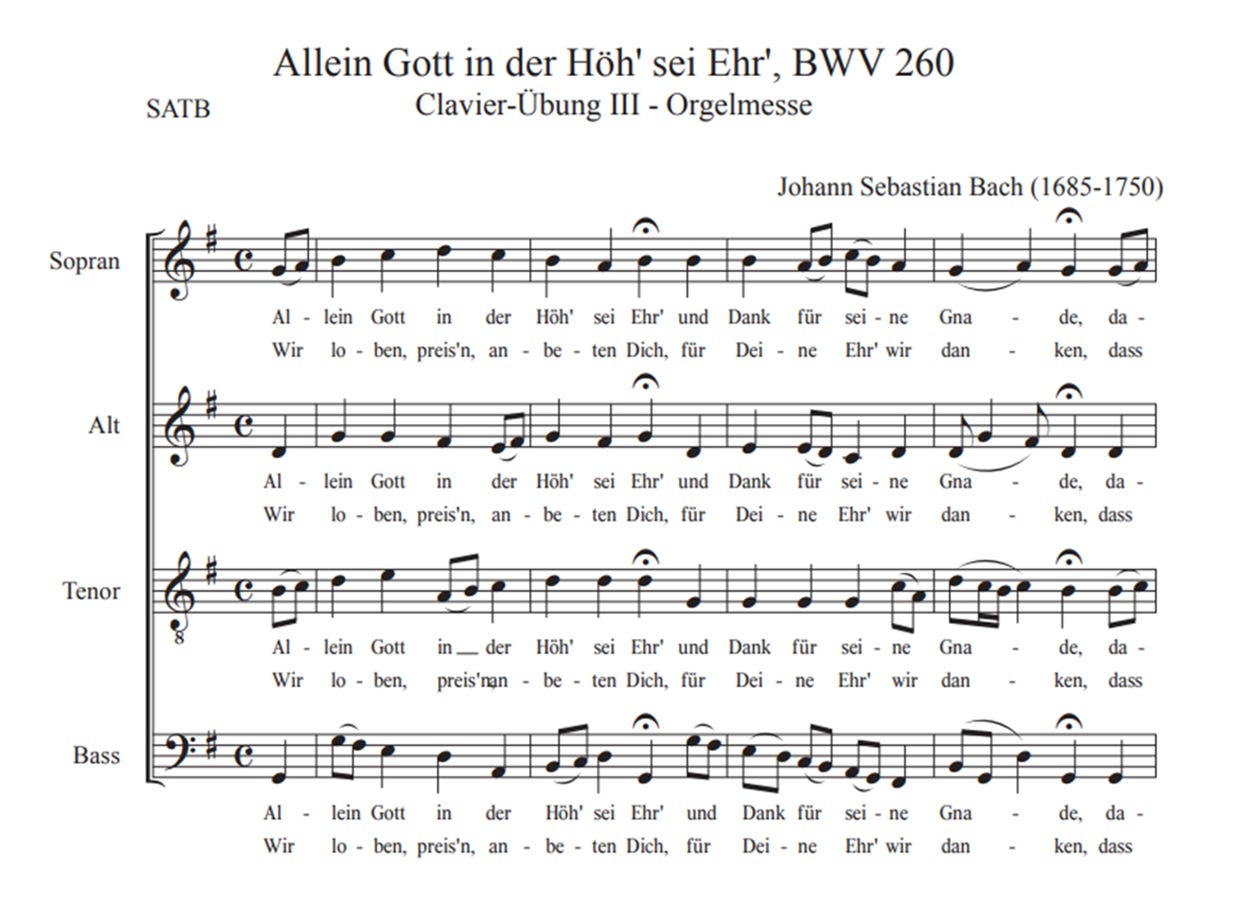
Unlike “normal” piano music, which is written in two staves, treble and bass, where the right hand takes the treble clef notes and the left hand takes the bass clef notes, music written in open score requires the pianist to make decisions about which hand plays which lines (four staves are not automatically compatible with two hands!). We also have a lot more visual information to take in at once. If you have ever studied piano, you know that there is a learning curve in playing two hands together at the same time. Not only are there physical mechanics involved, but the eyes need to “read” both the treble and bass clefs at the same time, scanning very quickly up and down and across. Imagine this times four voice parts, and you start to get an idea of the difficulty involved. To increase the challenge, the pianist must transpose the tenor line down an octave at sight.

A very accomplished solo pianist can look at parts written in open score for the first time and feel paralyzed. For one thing, we are trained to play every note on the page - but in open score, it is sometimes impossible to physically play all the notes (and playing all the notes is not always beneficial for the choir!). There is also the challenge of scanning four lines instead of two. And, unlike in solo piano practice, where we can take the parts one hand at a time and work slowly before putting them together, a choral accompanist does not have this luxury in the choir rehearsal. Rather, she is expected to read all of the parts in real time so that the choir members can hear what they are supposed to be singing.

It may sound daunting, but this is absolutely a skill that can be taught and acquired over time. And I’ve developed several workshops to teach this skill progressively. This most recent choral intensive combined my two workshops on How to Read Open Score with a newly developed workshop on Bach chorales. Taken together, the three workshops present strategies to read parts in open score progressively, from identifying harmonic foundations to layering parts to becoming a problem-solver and making wise choices about what to play and what not to play.

In our time together, these wonderful pianists were fully invested, asking great questions, and contributing to a collegial feel. They came in asking:

  • How to read the tenor line
  • What to do in fugal sections (how to decide what to play and what to leave out)
  • How to manage all the voice entrances
  • What to do with voice crossings
  • How to manage a director’s expectations when we’re expected to “play everything”

Each day we worked through workbooks on actual choral score excerpts from Bach’s cantatas, Haydn’s Creation, Handel’s Messiah, and more, marking the music and identifying strategies for scanning the score and identifying what is most important to play. I provided homework suggestions, tip sheets, a Triage chart, and appendices with even more music to practice after the intensive ended.
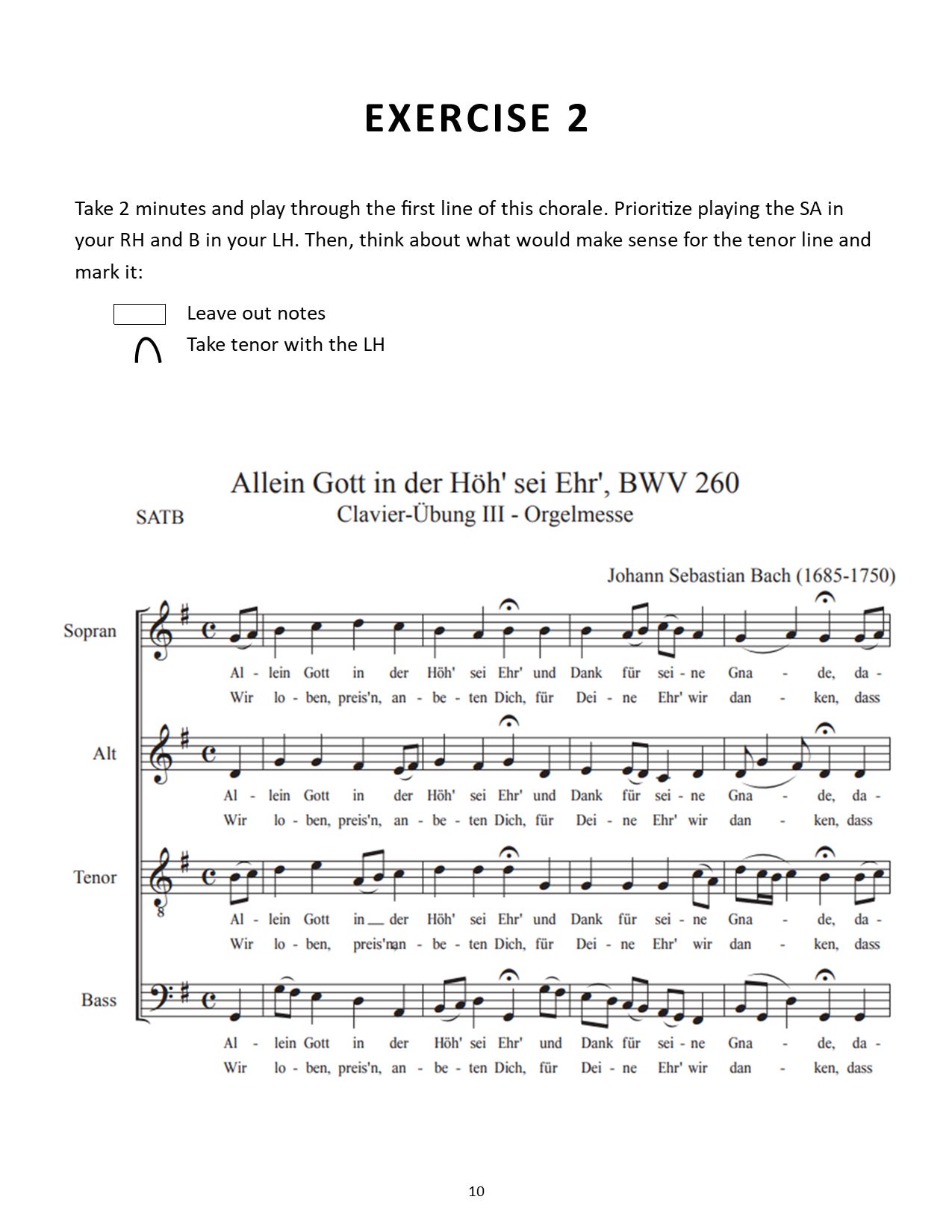
The participants were grateful for the training, commenting:

“Thank you so much for the session and knowledge!”

“Much, much gratitude!”

…and rating the intensive as “extremely valuable” in giving them strategies to improve their open score reading.

When asked what aspects of the workshop were most valuable, they said:

“Learning which parts of a score to prioritize”

“I'm not sure I could choose! info on voice crossings; the "triage" flow chart; the reminder it's OK to not play everything the first go-through when it's "at sight"

To my knowledge, this is the most comprehensive resource available to choral accompanists. Books and courses on accompanying often focus on playing for a singer or instrumentalist and considering things like balance, rapport, musicality, and interpreting the score. Choral accompanying may get a mention, but it is often not the focus of a class; however, it is a role most pianists will take on at some point in their lives. Inevitably, if you are a part of a school or church and people know you play the piano, you will be asked to play for the choir! Playing for a choir is also a nice way to earn consistent income, with its weekly rehearsals and seasonal performances (unlike freelancing, which is typically made up of one-off gigs).

I am happy to announce that the whole Choral Intensive is now available for purchase as a set of on-demand recordings, with their associated workbooks. In addition, there is ongoing support available through my Choral Accompanists Facebook group and individual coaching (click here and scroll to the bottom) offered for anyone wanting guidance on specific repertoire.

PURCHASE THE INTENSIVE

Summer is a fantastic time to invest in your own professional development and gain a toolkit of strategies for reading open score efficiently so that you keep your sanity while adequately supporting your choir. You can enter at your own skill level and choose which exercises are most beneficial for you to work on. Your confidence will grow as you learn to identify what to prioritize and your practice time will be more efficient as you learn to mark your score in ways that will help you succeed in rehearsal.
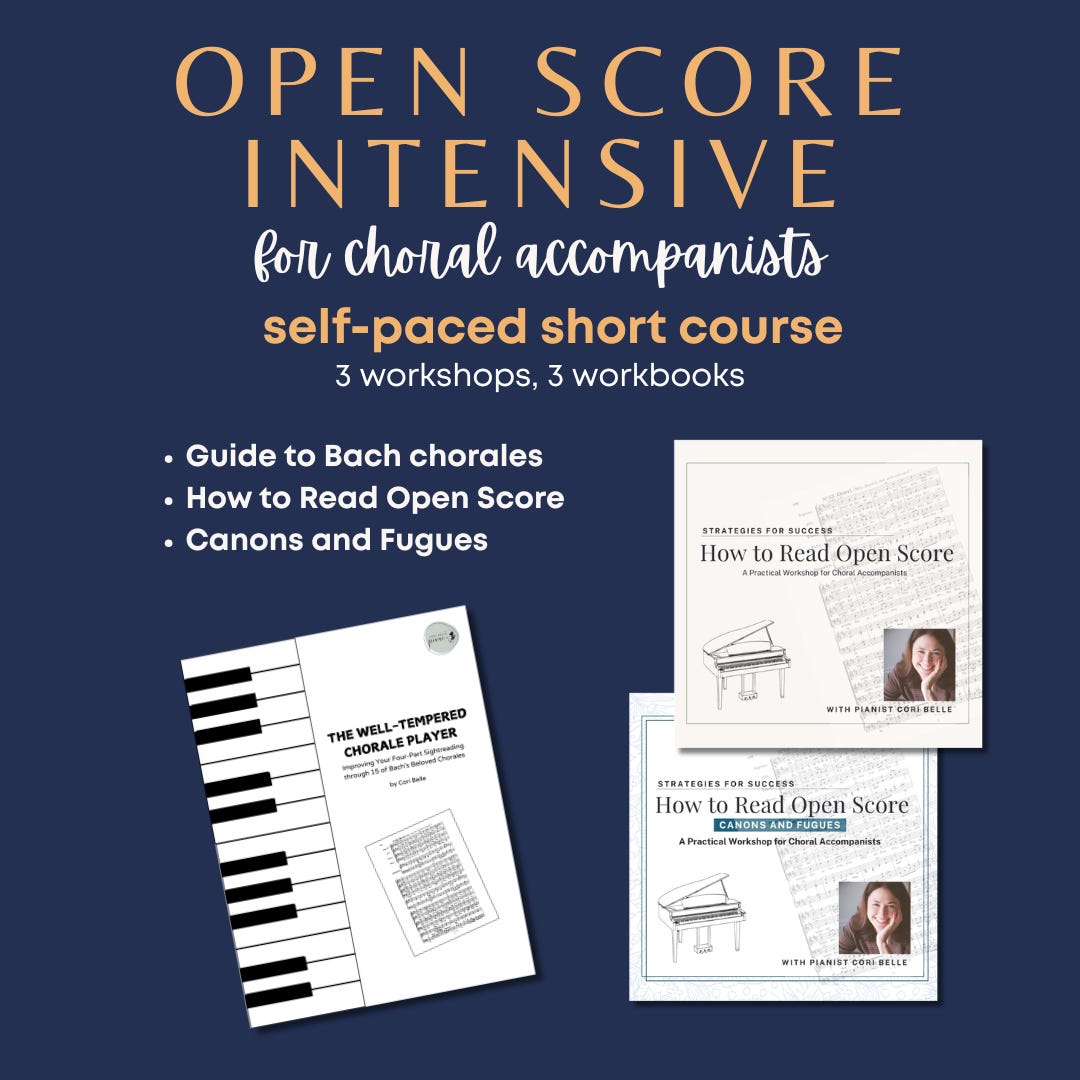
I hope you will take advantage of these materials or share this post with a friend! If you’re not quite ready to jump into the full intensive, the workshops are also available individually on my website, as well as a growing number of articles and resources on choral accompanying.

I wish you the best as you continue to work to support your choir. It is such a privilege to be able to make beautiful music with others. 🎶

Happy music-making!

My Journey into Choral Accompanying 

This post first had its home on my substack, At Home with Classical Piano, which is where I write regularly now. Come join me there, or subscribe to my newsletter to stay in the loop and get posts delivered straight to your inbox!

I fell into choral accompanying unexpectedly. I was in high school at the time, having taken private piano lessons for a number of years. I was a good sight reader and loved playing duets with my dad. There was a certain boy who sang in the top auditioned choir at my high school, and when he suggested that I come play for the group, I jumped at the chance.

Those first rehearsals were rough! I learned to “give pitches,” playing first the bass, then tenor, alto, and soprano starting notes; to read different lines at the same time; and to follow the conductor’s gestures. I ended up playing for all four choirs for the next four years, and then was hired “for real” when I graduated and I continued to play for concerts while pursuing my undergraduate degree in a neighboring city.

From there, I went on to major in Piano Performance and spent as much of my “free” time as I could accompanying choirs, opera and musical theater productions, and voice lessons and recitals. After I graduated, I played for an accomplished 100-voice church choir that sang at notable local concert venues as well as travelled.

I also did a ten-year stint in Musical Theater, not just as a pit musician, but as a Music Director, and I learned a lot about timing and balance between singers and instrument in my time there.

Once I married and had three children, life in the music lane slowed a bit, but I kept up my “chops” by practicing when I could, and though I let go of the church choir position when home life got too busy, I started to miss it. After a few years, I started to research local community choirs. I ended up going to a summer “sing” of masterworks where I introduced myself to the accompanist and offered to substitute if she ever had a need. That led to a number of jobs with different choirs, and I continue to sub and play for choirs today!

If you have ever wondered if you have what it takes to play for a choir, here are some things I’ve learned along the way that might encourage you in your pursuit of choral accompanying!

What are some of the musical skills needed to succeed as a choral accompanist?

A competent pianist, able to play hymns and some Bach Preludes and Fugues, maybe a Haydn or Mozart sonata

A good sense of rhythm

Ability to learn music quickly

A willingness to serve the music by following the director and doing whatever it takes to bring out the best in him/her and the choir

How should pianists prepare for a choral rehearsal?

The following tips come from my Timesavers for Choral Accompanists

Prep your score (put it in a binder, break the binding/cut it off and have it spiral bound),

Listen to a recording of the music with your music in hand

Know the choir entrances (mark your score)

Practice the accompaniment – have a basic idea and be able to “get through” from the first rehearsal, but then practice and polish on your own time throughout the season. You should be able to play from beginning to end without stopping, in support of the choir; and then your priority is listening to the voice parts and being able to play them in different combinations *especially entrances*; then, as the choir becomes more confident in their parts, your job is to enhance the score musically by paying attention to the conductor’s phrasing, tempo changes, and dynamics; lastly, your accompaniment is the “icing” on the cake – never the most important; it comes at the end, after the foundations are well established. (And if you are playing an orchestral reduction, not to perform at the piano at all, you will try to add color and “sound” as much like the orchestral instruments as you can.)

Take good notes in rehearsal – keep a pad of sticky notes next to your binder so you can jot down notes when the director is addressing the choir, and return to them later when you can practice on your own at home

Plan for page turns! Practice them just as you practice your notes and rhythms.

If you would like to see how I prep a score in real time, check out this post and video.

How to work successfully with a conductor:

Make it your goal to make the conductor look good.

Don’t draw attention to the conductor’s mistakes (dropped beats, defining an Italian word wrong, bringing the choir in a whole measure early/late)

Always follow the conductor!

Anticipate what the conductor is going to say and be ready (the choir missed an entrance, prepare to go back)

Be professional. Rehearsals are not the time nor place to air grievances about the director or about the members of the choir.

Address any concerns privately.

Ask, “Can you clarify when you want me to start? Will you give me a preparatory beat, or an entire measure, before you want me to come in?” “What tempo do you prefer here?”

If a collaboration during rehearsal isn’t working, assume it is a misunderstanding on your part. Try to clear it up by asking questions of the conductor.

It is normal to feel overlooked sometimes, or not acknowledged (although a good director will express gratitude for your work) – that is part of the job, and if you have done your job well the choir will know their parts and sing musically whether or not you end up performing with them in the concert; however, if there is a clear issue of disrespect, where the director is continually pointing out mistakes publicly or disparaging you, and you have tried addressing it in private to no avail, it may be time to cut ties and find another choir.

What are some tips for practicing open score?

First of all: If you just need more sightreading practice, make sure you’re reading music 1-2 levels below your playing ability. Read a lot of easy music to get used to scanning the music quickly and then keeping your eyes moving ahead as you play.

You want to get really good at moving your hands around the keyboard without having to look at them. In rehearsal, you will be looking up at the director from time to time, and keeping him in your peripheral vision all of the time. You need most of your vision to be on the music. That leaves little to no time for looking at your hands. I like to think that if I were blind, I could still play familiar pieces on the piano because my ears and hands would guide me. Get used to how chords and octaves feel in the hands, and even how things feel when you’re switching hand positions (I would say jumps, but really what your hands should do at the piano is shift horizontally - not jump.)

Practice basic 4-part open score reading using Bach Chorales. I have two resources available to pianists to help you develop this skill:

A Choral Accompanist’s Guide to Open Score Reading (free guide)

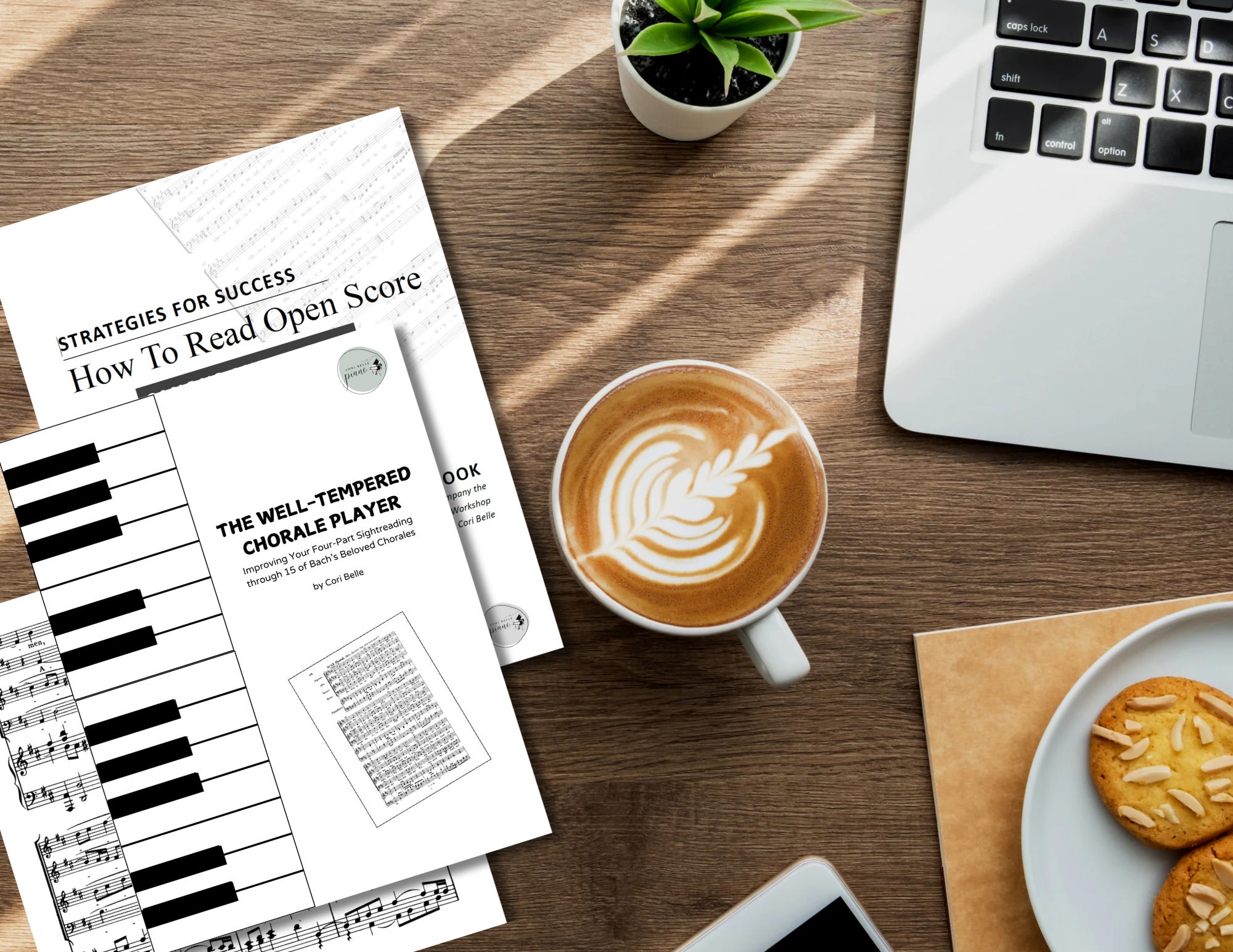
The Well-Tempered Chorale Player, a selection of 15 Bach chorales written in varying key signatures, including both major and minor keys

Additionally, I have an Open Score Summer Intensive coming up this June 18-20, 2026, where I will teach not only how to work through the Bach chorales, but also share tips and tricks for learning music quickly and prioritizing what is most important.

Join me LIVE for a three‑day online intensive offering practical, hands‑on analysis and guided open‑score practice for choral accompanists and directors, helping you confidently play everything from Bach chorales to fugues.


Learn more and register here.

Just get started!

The best practice is on-the-job! Find a choir. Start by offering to substitute for a local group.

Practice reading a lot of music – it doesn’t have to be choral music; work on reading straight through without stopping and without looking at your hands. Glance up from time to time as if you are looking for cues from a conductor.

Practice your open score reading using Bach Chorales. Take my summer intensive and get a toolbox of strategies that will serve you well in rehearsal. The intensive includes three great workbooks that will give you practice with a variety of real-life choral scores long after the course is over.

Check out more choral piano resources on my website! You’ll find lots of information about what the job looks like, how to tackle different scores, and how you can prepare to be successful as a choral accompanist.

The choir world is a unique one, in that it is made up of a wide variety of people. Of course, serious professional singers may be a part of a choir, but more often than not, choirs are made up of schoolteachers, psychologists, judges, lawyers, doctors, chefs, waitresses, actors, music teachers, firefighters, and every other profession that you can think of. The members may have minored in music, or they may just miss singing in their church choir. They may be proficient sight readers, or they may be fantastic aural learners who struggle to read music notation. Usually, every member can point to one significant musical memory from their childhood that got them “hooked.” And the best choir directors can take this conglomerate of people, musical abilities, and experiences, and weave their voices into a beautiful, unified tapestry of sound that touches the souls of those who listen.

If you are not yet part of a choir, I encourage you to look around and see what is available in your area! Check out a few concerts. Offer to substitute for the accompanist. Get involved in your local community and you will be rewarded with new friendships with people who love music as much as you do!

The Secret to Growing as a Musician: Listen to Yourself 

My formal training in piano stopped shortly after I completed my undergrad. I took a few graduate level courses at an international music school, but never ended up pursuing my master's degree. Yet, I have worked hard in the years since to maintain my skills and even to improve both technically and artistically. There were opportunities that presented themselves to me - like being offered the pianist position at my church and taking one-off lessons with a friend's teacher - and others that I intentionally pursued - like getting into the musical theater world and finding a community choir. But the thing that has grown me the most is something I never would have predicted: listening to myself play.

In 2018, my children were squarely in the grammar school phase and it occurred to me that I should try making a CD during the hours in which they were attending school. I'd recorded one before, with the help of friends who owned a small production studio, and we had recorded live tracks at a beautiful music center in the mountains. (Listen to that album here.) I'd also been a part of several live choral recording projects, so I was aware of the pressure to perform and the hyper-consciousness one enters when in such a situation. But I didn't want to record in a studio on someone else's instrument or even on a single day. My vision was to record on my own piano, in my own living room, over the course of weeks, taking a leisurely pace and listening to takes in between recording sessions.

Doesn't that sound fantastic? The reality was so much different (read more about that here). Between the piano developing weird clicks, airplanes roaring overhead, and the neighbors mowing their lawns, it was quite the experience! I learned a lot about self-recording and producing. But I learned a whole lot about myself as a pianist, too.

Listening to recordings of yourself is eye-opening and not for the faint of heart! The process of recording and my desire to share my music turned the heat up even more, and so for several months I scrutinized my playing ruthlessly. Everything was subjected to criticism, and I found myself asking, “What makes my playing different? What is my signature sound? How might I convey my personality and feelings about this music solely through sound? Who am I as an artist? What differentiates my sound from the thousands of existing recordings?”

The exercise was immensely stretching and so good for my playing. I became more concerned about accuracy, but also more intent on producing a beautiful tone. I wanted listeners to hear the shimmery top of my piano and feel like they were in my living room listening to one of my intimate house concerts.

In the end, the recording was far from perfect, and there are definitely things I would do differently a second time around. But it was mine. And I had emerged a better musician and pianist because of it. (Listen to the recording here.)

Why do I share all of this with you? Because too often we sit down and play the piano for the thrill of playing and we forget to listen to what we're producing. The physicality of playing is so absorbing that we forget to make music. Either we are facing technical challenges, or fingering difficulties, or odd leaps, or we're taking pride in how fast our fingers can fly and what kind of physical gymnastics we're capable of at the keyboard. It is so easy to forget about the sound. Even worse, when we are faced with a new piece of music, especially in a collaborative situation where we are playing for a choir, we get so hyper focused on playing the correct notes that we forget to breathe and sing the lines.

We have the incredible privilege of being musicians. Our goal is to make music. And the way we get there is to start listening.

In your playing this week, whether on your own or with a choir, I encourage you to listen intently to the sound you are making. Challenge yourself to be musical every time you sit down, even during a first reading. You will find that it makes the process so much more enjoyable, and your playing will be better because of it!

Keep up with my writing by subscribing to At Home with Classical Piano on Substack.

Working with the Choir Director: A Choral Accompanist’s Guide to Professional Collaboration 

Working as a choral accompanist can be very rewarding. There is nothing like supporting a group of singers from behind the keyboard: helping them to learn their parts, encouraging their progress, and then enjoying the fruits of our labor as we accompany them in concert. Carrying out a director's vision, anticipating what he/she is going to do before he/she does it, and contributing to the overall excellence and beauty of the music can be incredibly fulfilling. However, there are times when we work with directors and our personalities don't mesh well, communication is difficult, or maybe we are the better musician. Rather than cut ties and run, it can be worthwhile to try and make things work, especially if we are invested in supporting the choir members. Here are some ideas for how to remain professional and keep the peace while working in a less-than-ideal situation:

Make it your goal to make the conductor look good.
o    Don’t draw attention to the conductor’s mistakes (dropped beats, defining an Italian word wrong, bringing the choir in a whole measure early/late)
o    Always follow the conductor!
o    Anticipate what the conductor is going to say and be ready (the choir missed an entrance, prepare to go back)
o    Be professional. Rehearsals are not the time nor place to air grievances about the director or about the members of the choir.

Address any concerns privately. 
o    Ask, “Can you clarify when you want me to start? Will you give me a preparatory beat, or an entire measure, before you want me to come in?” “What tempo do you prefer here?” 
o    If a collaboration during rehearsal isn’t working, assume it is a misunderstanding on your part. Try to clear it up by asking questions of the conductor.
o    It is normal to feel overlooked sometimes, or not acknowledged (although a good director will express gratitude for your work) – that is part of the job, and if you have done your job well the choir will know their parts and sing musically whether or not you end up performing with them in the concert and whether or not you are publicly acknowledged. However, if there is a clear issue of disrespect, where the director is continually pointing out mistakes publicly or disparaging you, and you have tried addressing it in private to no avail, it may be time to cut ties and find another choir.

Being a choral accompanist means contributing to the success of the choir, and this requires professionalism and respect in our interactions with directors. Even in less-than-ideal circumstances, our professionalism and artistry can make a lasting impact. By choosing grace over grievance and collaboration over conflict, we not only support the choir’s success but also have the opportunity to grow as musicians and colleagues.

Keep up with my writing by subscribing to At Home with Classical Piano on Substack.

Getting Ready for Choir 

Are you ready for choir? My choir starts up next week after having taken 3 months off for the summer break, and I can't wait to see everyone and dive into some new music! As a choral accompanist, I don't need to worry about getting my voice back in shape, but I do need to get back to the piano in earnest and “warm up my chops” that have gotten a bit lazy over the summer!

Here are a few things I'm doing to get ready for choir:

  1. Clean out my tote bag. I was given this amazing, sturdy burlap “Chopin” bag years ago, and I use it for toting music to all my collaborative piano gigs.

2. Clean out my black piano binder, add a mechanical pencil and post-it-notes.

3. Commit to sitting at the piano 10 minutes a day. Since I don't have choir music yet, my goal is simply to get some music back into my fingers, focus my attention on reading, and enjoy returning to practicing music that has been on my shelf for a little while: Ravel's Jeux d'eau, Debussy's Sunken Cathedral, a Bach suite (Bach is SO good for reading multiple voices and practicing efficient fingering)…

Once you receive your music for the new season, you might want to check out my free guide, Timesavers for Choral Accompanists

Also, commit to arriving a few minutes early to each rehearsal. It can be tempting to show up right on time, but by showing up 10 minutes early, you build in time for unexpected traffic, give yourself the opportunity to connect with a choir member or two before rehearsal, and maybe even get a chance to quickly scan any new music the director hands you. Plus, arriving early helps you establish yourself as a leader, providing an example for others to follow and contributing to the overall professionalism of the group.

As always, you can find more resources specifically designed for choral accompanists at CoriBelle.com/Choral-Piano

Looking for something more? Feel free to shoot me an email!

Keep up with my writing by subscribing to At Home with Classical Piano on Substack.

The Role of a Choral Accompanist 

Picture yourself sitting at the piano. You listen to the choir, play their parts as they sing, and follow the conductor. As you scan the score, you suddenly notice an upcoming tenor entrance that is sure to go awry. You make a quick decision to pull back on the other voice parts, leave out the soprano melody, and play the tenor entrance clearly and on time. The tenors nail the phrase, the conductor stops to address a diction issue with the choir, and you all return to the beginning to review the section again. This time, you play all parts equally and listen to see if the tenors can get their entrance without your help. They can. You sit back, proud of the tenors, and full of the satisfaction that comes from preventing a train wreck. You are the Invisible Conductor.

Has this happened to you? 

A good choral accompanist makes many decisions like this “behind the scenes,” many times without the conscious knowledge of the director or the choir. The accompanist is the “invisible” conductor, contributing to the success of the choir technically (playing the right notes), musically (playing with expression), and artistically (working in tandem with the director to accomplish his or her artistic vision for the music). The accompanist functions as a co-leader with the director in bringing out the full potential of a choir.

Why do I mention leadership in what is obviously a subordinate role? Because a good choral accompanist is a leader, leading the choir (and sometimes the director) by example. The accompanist is confident in her skillset, knowledgeable about how best to support choral singers, and willing to submit (to the director) or lead (in partnership with the director, or in the director’s absence) as the role requires.

The choral accompanist holds two main roles: that of rehearsal accompanist, which requires one to play all of the vocal parts during rehearsal as well as learn the accompaniment, and which may include leading vocal warm-ups, rehearsing singers in sectionals, and substituting for the conductor in his or her absence; and that of performance accompanist, often the sole musical support for the choir, but sometimes called upon to be part of a chamber ensemble, orchestra, or to provide accompaniment for guest soloists. The two roles vacillate between leadership and support, requiring the accompanist to lead and to follow as the situation requires.

At the time of this writing, I have been accompanying choirs for over 30 years. I began by playing for my high school choir and church youth worship team, and have played in multiple schools, churches, and community choirs. I have experienced good and bad directors, high praise and harsh criticism, being barely acknowledged and receiving flowers and honorariums. Though choral accompanying has never become a full-time gig for me (I am not aware of anyone for whom this is true), it has remained a steady part of my life and has stretched me personally and musically more than I could have imagined when I began at the age of 14. When you find the right fit in terms of ensemble and director, being a choral accompanist can be incredibly fulfilling – more than a paycheck, it can bring you like-minded community, networking opportunities, musical fulfillment and validation; and it can grow your skills in leadership, communication, and collaboration.

If you play for a choir, there is much you can do to sharpen your skills, grow as a musician, and work in tandem with the director to bring out the best in your choir. I have a growing library of resources designed specifically for choral accompanists including online workshops on how to read vocal parts in open score. You can take a look here.

And let me know if there is a specific question you have or resource you would like pertaining to your role as choral accompanist. I'd love to help!

Keep up with my writing by subscribing to At Home with Classical Piano on Substack.

New Choral Workshop: How to Read Open Score-Canons and Fugues 

How to read open score canons and fugues choral accompanist workshop

I am excited to announce a new online choral accompanying workshop: How to Read Open Score Canons and Fugues. 

This is a follow-up to my original “How to Read Open Score” workshop and will build on some of the same ideas (scanning a score, prioritizing which voice parts to play at what time). Note: There is no prerequisite to attend the first course in order to benefit from the second, especially if you are already comfortable reading Bach chorales in SATB.

When voices move in canon or fugue, they “take the road less traveled” and break out on their own independent paths, wreaking havoc for the choral accompanist. But there is no need to panic! It is possible to make sense of the divergent vocal lines and maintain a solid presence at the piano while giving support to the singers. 

Join me for an on-demand online workshop and we will discuss practical strategies you can use to tackle canons and fugues in open score with confidence. All attendees receive a student workbook with exercises to work through during the class as well as extra music to work on after class to extend your learning. In addition, you will receive an invitation to a new choral accompanist community online where you can ask further questions and receive support for your work.

I hope to see you there!

Click here to join the workshop!

What Makes a Great Choral Accompanist 

The role of choral accompanist has a direct impact on the success of a choir. With a great director, a choir can accomplish much; with a great director + a great accompanist, the sky is the limit! Without a great director, the accompanist can still be a powerful catalyst for growth, covering over “a multitude of sins” and gently filling in gaps to bring forth beautiful music. Conversely, if an accompanist lacks skills and/or professionalism, it will affect the tenor (pardon the pun) and musicality of the group. 

If you currently serve a choir as their accompanist, your work at the piano in rehearsal is as important to a choir's success as the foundation of your house is to the home in which you live! 

Here are a few thoughts on what you can do to enhance the focus, accuracy, musicality, and overall professionalism of your choir:

Qualities of a Great Choral Accompanist

  1. A great choral accompanist is proficient at the piano. Playing well technically and having a good understanding of music theory and form will enable you to learn music quickly.
  2. A great choral accompanist anticipates what the director is going to do next. A “good” accompanist “follows” the director; a “great” accompanist is so focused on what the conductor is doing that he or she can anticipate things like: what problem spot the director will go back to rehearse the choir at, where in the music the director wants more rubato or expression, and when more support of the vocal lines is needed. 
  3. A great choral accompanist isn't easily offended, but recognizes the need of all musicians (including him/herself) for continued growth and problem-solving.
  4. A great choral accompanist is efficient in home practice time. When given a stack of music at the beginning of a season, prioritizing what needs work first is essential. (For help with this, check out my free resource, Timesavers for Choral Accompanists, below!)
  5. A great choral accompanist is receptive to the needs of the choir. You are the director's second pair of ears and can often hear things that the director misses. Take the initiative to bring out certain vocal lines that choir members need help with when learning parts, and be available to choir members who might want a little help during the break.
  6. A great choral accompanist is always professional. Your role is more akin to that of the director than the choir members. As a leader in the group, your attitude toward the director, the music, and the choir members will affect others. Set an example by not engaging in gossip, working to build up rather than tear down, being prompt to rehearsal (early is better!), and being focused during practice.

If you are currently serving a choir, consider it a great privilege to be the “unseen conductor.” The choir relies on you for its support. Continue to hone your skills, striving always to be better than you were the week before, and let it bring you great satisfaction that you are contributing to the success of your choir!

Resources for Choral Accompanists

For more support and encouragement in your role as choral accompanist, check out these resources:

Choral Accompanists Facebook Group (click the image)

choral accompanist facebook group

Timesavers for Choral Accompanists (click the image)

timesavers for choral accompanists

How To Read Open Score: On-Demand Workshop for Choral Accompanists (click the image)

how to read open score workshop for choral accompanists

Find more resources in my growing library for choral accompanists at coribelle.com/choral-piano

Keep up with my writing by subscribing to At Home with Classical Piano on Substack.

How to Find Accompanying Gigs 

Working as a freelance accompanist and independent contractor often means looking for work. While we would all like to receive the word of mouth gigs that show up because people know us and like what we do, the fact remains that there are times when we need to market ourselves and find our own work. Here are four ideas of where to find accompanying gigs, and what you need to do in order to land them!

1. Narrow down exactly what you want to do! 

There are so many options available to collaborative pianists:

  • Vocal accompanying
  • Instrumental accompanying
  • Playing for church services
  • Weddings
  • Working in musical theater in the pit band, as a rehearsal accompanist, or as a musical director
  • Playing for school choirs
  • Playing for a ballet company
  • Play on a cruise ship
  • Play for local student festivals like solo and ensemble
  • Record accompaniment tracks or play for auditions
  • Play for your local opera company

2. Let people know you’re looking for work.

Start with friends and family – let them know you are available to play for [fill in the blank]. Go to the places and individuals you’d like to play for and let them know you’re in town and available for hire. If you can, get in front of people and play for them. Offering your services as a sub can get your foot in the door and serve as a sort of on-the-job interview!

Connect with local musicians. Start with a local Facebook group and look for musicians’ meet-ups. Or ask someone to coffee. Get to know who works in the area and ask them to help spread the word that you’re looking for work.

Email choir teachers at local schools. Find out if they need an accompanist for choirs, musicals, or their annual solo and ensemble festival.

3. Look online

Join your local Facebook groups. In the last several years, many local musicians groups have showed up online. Start looking for location-specific groups of piano teachers, accompanists, pianists, and musicians. Some cities even have groups that function as job boards, where you can find gigs. Introduce yourself to the group, check in often, and take advantage of opportunities to get in front of people and play.

4. Advertise online

Pianoaccompanists.com offers a free listing of your contact info and can be a good first online presence for jobs. You can also set up a simple webpage with your name, a short bio, and contact information. When people reach out to you, be quick to respond (within 24 hours) and clear about whether you are or are not interested/available for the gig. Think of every contact as a networking opportunity and make a good first impression. Even if you aren’t available or don’t end up getting a gig, people will remember how you treated them and if you were prompt and polite with your communication. Maybe you’ll get a future call back!

The jobs are out there, and once you make a few connections, things seem to start happening. It will take time to get “known,” but once you have a solid regular gig, whether with a school, church, music studio, or community organization, more work will come your way!

Keep up with my writing by subscribing to At Home with Classical Piano on Substack.

How to Read Choir Music with Four Parts  

how to read choir music with four parts

If you play for a choir, chances are you have been asked to play “open score” in rehearsal. If you are unfamiliar with the term, “open score” refers to the way the music is laid out for a choir: each voice part (soprano, alto, tenor, bass) has its own line of music written on the treble or bass staff.

Why is Reading SATB Open Score So Difficult?

Pianists struggle with reading open score because they are used to reading only two clefs - treble and bass – joined together. In general, the right hand plays the treble clef notes and the left hand plays the bass clef notes. However, when faced with four lines on different staves, the pianist is forced to make choices about which hand plays what.

Additionally, the choral pianist must quickly scan the separate voice parts and decide immediately how to cluster notes together, so that he or she can play as many of each voice parts' notes as possible. Often, it is physically impossible to take all of the notes from all of the voice parts and play them all at the same time.

How Can I Make Sense of Reading SATB Open Score Vocal Parts?

Prioritizing what to play and what to leave out is an essential skill for a choral accompanist, one which is often learned during rehearsal in front of 20-100 people. Talk about a high-stress situation! Usually, the pianist’s response is to go home and try to practice all four parts at the piano, away from prying eyes, and hope for better results next time. However, this really isn’t the best use of time. It would be better for the choral pianist to learn how to prioritize what the choir needs most, mark the score accordingly, and practice that. After all, the voice parts are often only 50% of what the accompanist needs to practice; if there is a piano accompaniment, this also needs to be learned and polished!

What Tools Can Help Me Learn How to Read SATB Open Score?

There are very few resources available online, at least at this writing, for the choral accompanist to learn the skill of open score reading. This is why I have put together a growing collection of tools, a few of which are mentioned below:

A CHORAL ACCOMPANIST'S GUIDE TO OPEN SCORE READING

This free guide will take you step-by-step through identifying harmonies and practicing the different voice parts in a chorale from Bach's St. Matthew's Passion. 

free guide to open score reading

THE WELL-TEMPERED CHORALE PLAYER

This guide takes you a step further with practice in all the major and minor keys in which Bach wrote his chorales. 

Guide to sightreading open score


HOW TO READ OPEN SCORE WORKSHOP

This 40-minute workshop is available on-demand and is accompanied by a 37-page workbook with practical guides and charts to help equip the choral accompanist with the strategies needed to successfully navigate choral music in open score. 

During the workshop, I discuss a progression of strategies that you can try to help you quickly scan a score, decide what is important to prioritize, and mark your score to assist your playing. We work with several choral scores in real time so that you know exactly how to mark your score. The workbook includes an appendix with additional music that you can practice after the class. 

how to read open score workshop for choral accompanists

JOIN THE CHORAL ACCOMPANISTS GROUP

There is a new community of choral accompanists forming online where you can find support and encouragement, share your progress, and celebrate your success! Come on over, introduce yourself, and share your stories and questions!

choral accompanists facebook group

I have plans to expand the resources available to choral accompanists, so keep checking back in! There are several ways to keep in touch: sign up for my monthly newsletter, subscribe to my blog, and bookmark the webpage coribelle.com/choral-piano.

I hope this encourages you in your choral accompanying journey and provides you with some resources to further your skillset and help you bring out the best in your choir.

Happy music-making!

P.S. Do you know an accompanist who would benefit from these resources? Please share this post with them!

Keep up with my writing by subscribing to At Home with Classical Piano on Substack.

Join the Open Score Summer Reading Challenge! 

Open Score Reading Online Challenge for choral accompanists with pianist Cori Belle

Want to feel more confident reading open score this fall?

If you took my How to Read Open Score workshop, you learned practical strategies to simplify the process. But if your workbook’s been gathering dust—you're not alone!

This July, I’m hosting a 4-Day Open Score Challenge just for choral accompanists.

We’ll spend 15–20 minutes a day working through the appendix exercises from the workshop workbook. You'll get:

  • Daily accountability and guided practice
  • Space for Q&A and community sharing
  • Encouragement to help you follow through

By the end, you’ll know how to make smart, musical choices at the keyboard—and feel great doing it.

Whether you're picking up where you left off or starting fresh, this is your summer confidence boost.

🎼 For Workshop Alumni

Already joined the workshop? Pick up where you left off and bring your workbook to life—join the Challenge for just $9!

🎶 For Newcomers

New to Open Score reading? Grab the Workshop + Challenge Bundle for just $35 and get everything you need to read with confidence this fall!

Learn more and sign up HERE!

Bach Chorales for Practicing Open Score Reading 

Open score reading is one of the hardest skills to master as a choral accompanist. The average pianist is pretty adept at reading music as traditionally laid out: treble clef and bass clef; however, with open score, the music is spread out and difficult to take in all at once. Typically, we see choir music scored either with soprano and alto joined in the treble clef and tenor and bass in the bass clef, or with each vocal part on a separate line as follows: sopranos, altos, and tenors on their own lines written in treble clef, and the basses notated on the sole bass clef staff. Of course, there are exceptions that go beyond “simple” SATB reading, but this is where the majority of choral music lies. So, what is the choral accompanist to do?

Just as pianists have to grow in their sightreading abilities with a traditional score, choral pianists have to grow in their sightreading abilities with open score. The best way to develop fluency in either case is to read a lot of music at a lower level. 

Think about a child who is learning to read. A child begins by recognizing letters as representing sound, then strings the letters/sounds into a word. A first reading experience might look like reading a single word on a page accompanied by a picture: c-a-t. As the child progresses, he or she will start encountering some of the same letter combinations (words) over and over, developing a vocabulary of words he or she can read “at sight.” 

The same thing happens with a pianist. We begin with recognizing step (seconds) and skip (thirds) intervals, moving up or down or staying the same, and then we add to that vocabulary with bigger intervals, chords, and longer strings of “words” in the form of scales and arpeggios. But if we move too quickly into harder-to-decipher patterns, our fluency lags behind. We end up with a disconnect between our playing ability (higher) and our reading ability (lower). To fix this, we must read a lot of music at a level lower than our playing ability in order  to build up our ability to recognize patterns quickly.

How to Read Open Score choral pianist workshop

For the choral accompanist interested in improving their skill in open score reading, I have put together several resources. One is the online workshop for How to Read Open Score. This gives a step-by-step overview of different scenarios one will face in choral accompanying, along with practical exercises for becoming more aware of what is happening on the page, how the voices are moving, and what is most important to play at any given time. 

Another resource I have put together is The Well-Tempered Chorale Player. This is a collection of Bach chorales notated in open score for the purpose of developing the skill of reading SATB vocal parts that mostly move together (homophonically).

Bach chorales for open score sightreading open score practice choral accompanying

I have found that most collections of Bach chorales available today tend to either be choral parts written on two staves, or simply a keyboard reduction or realization of the parts. While both are helpful in giving the pianist an overview of the melodic and harmonic structure, neither are very helpful for practicing open score reading. The solution is found within each choral score of the Bach cantatas themselves, which offer both the voice parts on separate staves and a piano reduction suitable for accompaniment. I have selected 15 chorales from these works for you so that you do not need to search through each full cantata in order to find what you are looking for!

The chorales in The Well-Tempered Chorale Player are ordered loosely in the circle of fifths, so that you progress from reading in C major to the flat and sharp keys. Major and minor keys are both represented, and you will notice that all of the keys in which Bach wrote the chorales are represented in this collection.

Lastly, I host a Community of Choral Pianists on Facebook where like-minded choral accompanists can exchange ideas, ask questions, and get support for their work. 

I hope you take advantage of one or more of these resources as you seek to build up your skills in reading open score for the benefit of your choir!

Keep up with my writing by subscribing to At Home with Classical Piano on Substack.

Free Billing Software for Collaborative Pianists (Accompanists) and Piano Teachers 

free billing software for collaborative pianists accompanists and piano teachers

Do you have a good system for billing, either for collaborative work or piano teaching, or both?

For the past two years I have used the free version of an online software called Wave for invoicing and all of my accounting. I have found it to be a great way of keeping track of my business finances.

Currently, my business activity consists of accompanying a weekly community choir, teaching a private piano studio of 11 students, selling digital products online, and collaborative freelance gigs. By using Wave for all of these activities, I am able to:

  • Use a customizable invoice template with my logo and business information
  • Save customer contact information
  • Keep track of paid and unpaid invoices
  • Record sales
  • Record expenses
  • View and print reports for accounting and tax purposes
  • Duplicate past invoices for recurring charges
  • Create categories and descriptions of recurring billable activities that Wave displays in a drop-down menu (45-minute piano lesson, 30-minute piano lesson, 30-minute rehearsal and Solo and Ensemble performance, 2.5 hour choir rehearsal, etc.)

There is some legwork on my end to get invoices to my clients. The free version of Wave only offers a link or downloadable PDF of invoices, so I have to email each customer when I am ready to bill. For now, I am willing to invest that bit of time in exchange for getting to use a free tool. Wave does have automations available for paid subscribers, so that is an option for those who want that feature. At any given time, I am able to view a report of income and expenses broken down by categories I have assigned. There are many reports available at the click of a button!

Wave is a great tool for collaborative pianists (or “accompanists” if you prefer the old school title!) and piano teachers to keep track of billing and payments in a professional, organized fashion. I encourage you to give it a try!

Keep up with my writing by subscribing to At Home with Classical Piano on Substack.

Image credit: David Yonatan González from Pixabay

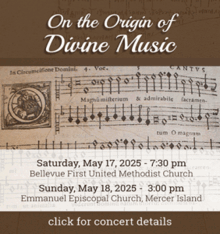
On the Origin of Divine Music 

I just came off of a big concert weekend, having accompanied a cello recital and two choral concerts: two very different experiences! The cello recital consisted of a number of cello students ranging from beginner to advanced, playing standards from the Suzuki books as well as repertoire by Beethoven, Saint-Saens, and Dvorak. In contrast, the choir concerts were performed by an auditioned adult community chorus and focused on sacred texts in various settings throughout music history.

“On the Origin of Divine Music” was the title given the choral performances, and though much of the music was acapella (not requiring my services at the piano), it ranks among my most favorite programs. The concept was taking six sacred texts and looking at two different ways composers set them to music. This is how it looked:


Historic Set:

Renaissance: Magnum Mysterium – Tomás Luis de Victoria

Baroque: Cantate Domino – Claudio Monteverdi

Classical: Ave Verum Corpus -Wolfgang Amadeus Mozart  - (piano and cello)

Romantic: “Wie der Hirsch schreit” from Psalm 42 - Mendelssohn  (piano and cello)

20th Century: Salve Regina – Herbert Howells

Modern:  Alleluia! – Elaine Hagenberg

 --Intermission—

 Contemporary Set:

Magnum Mysterium – Morten Lauridsen 

Cantate Domino - Karl Jenkins (percussion)

Ave Verum Corpus – Imant Raminsh 

Psalm 42 – Andrew Bleckner 

To the Mothers In Brazil: Salve Regina - Gunnar Eriksson (percussion and cello)

Glory, Glory Hallelujah! - arr. Howard Helvey (piano and percussion) 


Not only did this make for an interesting and varied concert, but it also was an exposition of some of the most beautiful choral pieces that have been written. I hope to have a link to recordings of our performance soon, but for now, enjoy this setting in Hebrew of Psalm 42 by Andrew Bleckner:

The translation is as follows:

As a deer longs for flowing streams
So my soul longs for you, O God
My soul thirsts for you
O Beloved, the living God
When shall we meet face to face?
Why are you so desolate, my soul?
why so distraught within me?
Hope in the divine source of all!
For I shall praise the Holy One
My ever present saviour, My God.

For the contrasting setting by Felix Mendelssohn, see my blog post here.

Keep up with my writing by subscribing to At Home with Classical Piano on Substack.

Exercises in Open Score Reading for Choral Accompanists 

Choral accompanists facebook group

After attending my How to Read Open Score workshop (still available!) and practicing the exercises in the accompanying Student Workbook, you might want more exercises in SATB open score reading. Here are some that I recommend:

Brahms Liebeslieder - These are wonderful dances. I have them scored for SATB and piano duet accompaniment! Some go quite fast, but you don't have to practice them fast. Often you just have two voices moving at a time. When SATB all sing, it's usually homophonic, forming chords. It would be a good next step after my workshop for continuing your practice with some of the things we talked about. 

Schubert Magnificat - This is also quite accessible. It is a 3-movement work. A good one for marking unisons and making choices as to which 2-3 voices to prioritize out of the 4 on a first reading. There is a little bit of practice here for prioritizing vocal entrances as well. 

Haydn Creation - We worked from "Awake the Harp" in our workshop. There are a number of solo movements in this piece. I would suggest looking at #13 "The heavens are telling the glory of God" and #26 and #28 which are two settings of "Achieved is the glorious work." All three of these movements are for chorus only, set in SATB, and which will require you to make decisions about what you want to play. 

Haydn Nelson Mass - This is a multi-movement work for soloists and chorus that combines all the elements from above - marking unisons and parts, homophonic movement, deciding which 2-3 parts to prioritize, some individual vocal entrances but not too crazy. 

These are all good starting places, if you're not quite ready to dive into more complex work like the Bach fugues! 

Want more resources? Check the Choral Piano page or join our new Choral Accompanists facebook group! 

Keep up with my writing by subscribing to At Home with Classical Piano on Substack.

How To Read Open Score Workshop for Choral Accompanists 

Last Friday I had the privilege of hosting an online workshop on How to Read Open Score for choral accompanists. In addition to the 40-minute workshop, each participant received a 37-page student workbook which contained practical exercises for use during the class, as well as several charts to guide one's initial assessment of a score (Secrets to Open Score Reading, A Snapshot for Open Score, and Triage for Open Score), and several appendices of musical selections to work on after completion of the class. I am happy to report that the majority of those attending found the class to be “extremely valuable” and “extremely relevant” to their role as choral accompanists.

What fun it was to share strategies that I use at the piano to assist singers in learning their parts! Open Score reading does not have to be scary. My goal with the workshop was to show pianists how to look at a score, mark it, and prioritize what is most important to play. 

It is a common misconception that being good at Open Score reading means one must play all the notes. This is simply not true. Singers need a solid rhythmic and harmonic foundation, and they need to be able to hear their parts voiced at different times in the music. A pianist needs to know what to prioritize so that he or she can lead the singers to hear what they need to hear in order to learn their parts well.

I hope that you, too, will find this to be extremely valuable in your pursuit to become more excellent at Open Score reading and supporting your choir in the best way possible!

Click here to go to the workshop.

Eric Whitacre and The Sacred Veil 

Eric Whitacre is a beloved choral composer. I love what he does harmonically with his music, and up until now I have loved every piece of his that I have heard. Recently I have been sitting with his 12-movement work, The Sacred Veil, in a sub assignment for a local community choir.

I confess, I have trouble with the work. It starts with a couple’s meeting and falling in love, and then quickly dives into a cancer diagnosis. The bulk of the music tells the story of the family grappling with the progressive loss of their wife and mother who died at the age of 36 of ovarian cancer.

The poetry is exquisitely set. There is no question that Whitacre is a master at setting text. The music is lovely, beautiful, perfectly expressing the love of a man and a woman, of a woman for her children, of the tenderness in their relationships. It is also harsh, frantic, desperate, portraying the awful reality of facing a fatal diagnosis and losing a cherished loved one. The whole work is undergirded with sadness and awash with the shadow of death. 

I understand this is the reality that many cancer patients and their families must grapple with. I understand the gravity of their experience, the crippling fear at hearing a fatal diagnosis, the trauma and anger and despair that arise and threaten to take hold during this kind of trial. I don’t think any of that should be minimized or dismissed. But I question why it must be put into an artistic work that a director and group of singers must sit with for weeks on end. Why would you want others to taste any semblance of your trauma and grief? What is the point of taking an audience through this journey? Why would anyone who has faced similar circumstances want to relive their struggle?

As artists, we strive to communicate honestly and meaningfully with our audience. We want to share something with them that will touch them emotionally, offering a piece of us – something that we have learned or gained from the music itself or that it has allowed us to express from our own life experiences.

I think Whitacre wrote this work because he loved his friend, the poet who lost his wife. I think it was his way of saying, “I see you, I understand what you are going through/went through, and I love you.” It is deeply personal for both of them.

Maybe that is what solace we can offer friends when they go through desperately painful times – our presence, our trying to make sense of their struggle as they go through it, our love. How wonderful to have friendships like these – but in our darkest hours, when friends aren’t around, we need something more. 

In desperate, painful times, we need something beyond human connection; we need the divine. We need supernatural intervention, comfort, hope. We can’t find it in ourselves, in trying to be strong for others, in accepting the inevitability of death with no tomorrow. 

Music offers temporary solace, but even it is not enough to buoy us when we feel like we are drowning. That kind of strength and hope can only be found in Jesus, the very person of God who broke into our world in human form, who bore our sorrows and sat in our grief – the effects of our sinful rebellion against God – and took the wrath of God due us upon Himself as He died on the cross. Many musical works have been written about His tragic death. But the story doesn’t end there; He rose from the dead three days later, proving His victory over death once and for all, offering hope to all who look to Him and believe. We no longer have to sit in our grief, because it isn’t the end. For the believer in Jesus, death is freedom from the troubles of our world and the doorway into eternal life. His presence is the soul-sustaining strength that we need to bear our burdens in life.

I have much respect for Eric Whitacre’s beautiful artistry in composition, and I will rehearse this piece with choir and orchestra with all the attention and expression that I would give to any choral masterwork. But I wish he would have included the hope of the gospel – the life-giving message of freedom from the fear of death, and the unmatched love of our Heavenly Father shown in the gift of His Son, Jesus Christ. 

I wonder if Whitacre knows that the Sacred Veil has been torn clear through, for on the day Jesus died on the cross the veil in the Jewish temple in Jerusalem was split in two, signifying His ultimate defeat of death. I wonder if he knows there is a path to true life, a way for us to connect with God Himself in this life as well as in the life to come?

Maybe his next project could be a re-setting of the text of Brahms’ Requiem, which comes from the Lutheran Bible and offers incredible hope and peace, both now and for eternity.

To hear Eric Whitacre’s thoughts on The Sacred Veil as a whole, as well as what inspired each individual movement, take a look at his video clips here.

See the piece live and in person as Kirkland Choral Society teams up with Philharmonia Northwest to present it this May. Get your tickets here.

Keep up with my writing by subscribing to At Home with Classical Piano on Substack.

Mendelssohn's Psalm 42 for Choir 

One of the blessings (curses?) of being a musician is getting to hear music in your head all of the time. Usually, it is music from a recent rehearsal or practice session. My most recent ear-worm is a phrase from Felix Mendelssohn's choral setting of Psalm 42. The choir I currently play for, Bellevue Chamber Chorus, is singing the first movement (also entitled As pants the hart), accompanied by myself at the piano, in our upcoming concert of sacred music, so we have been studying the piece for several weeks now. 

Psalm 42 Wie der Hirsch schreit (As pants the hart) is a cantata for choir, soloists, and orchestra. Schumann commented that the work was the “highest point that he [Mendelssohn] reached as a composer for the church. Indeed the highest point recent church music has reached at all.” Mendelssohn himself described it as “my best sacred piece… the best thing I have composed in this manner”, a work “I hold in greater regard than most of my other compositions.” Indeed, it contains what I love most about Mendelssohn's music: beautiful elongated musical phrases that terrace one independent voice line on top of another until they all come together in chordal harmony at the end of the phrase. 

The entire text of the first movement is “As the deer pants for water, so my soul thirsts after Thee, oh God.” Each time Mendelssohn sets the words “nach frischem Wasser” (for fresh water), the melody rises, as if the deer is reaching up, or moving towards, the water. Similarly, when he sets the word “schreit” (literally “shouts” or “cries” or longs for, in the phrase “my soul thirsts/shouts after Thee”), he emphasizes it most often by leading the melody upwards. This happens only when my soul cries out, not when the deer cries out!  The deer pants for fresh water, but my soul cries, God, to Thee. Of course, the word order is different in German, but you get the idea. 

That Mendelssohn would so deliberately paint the text in this way indicates his deep understanding of the text and the way music can work in tandem with words to communicate an idea in a richer way. His artistry enhances the original poetry and affords the singer, and the listener, opportunity for reflection as he has each voice part repeat snippets of phrases over and over until they come together in full chorus. If only modern worship songwriters would take this to heart! 

Listen for yourself to a recording of this wonderful piece:

Then, mark your calendar for a chance to hear it live and in person! Bellevue Chamber Chorus will perform it on May 17 and 18, and you can buy tickets and find online streaming information here.

Incidentally, the first movement is also a great exercise in open score reading. You can find a free copy of it here.

Keep up with my writing by subscribing to At Home with Classical Piano on Substack.

How to Boost Your Summer Piano Teaching Income 

We all want paid time off, right? But how do you manage that as an independent piano teacher? Let me share a few ideas with you!

  1.  Schedule it into your existing studio calendar. (Hopefully you are currently implementing a Tuition-based model. If you aren’t, check out this article on why you should!) Depending on how you run your studio, you may choose to charge tuition for a 9-, 10-, 11-, or 12-month calendar year. Your tuition can include monthly private lessons for a certain number of months along with a required summer component (either a set number of private lessons, a camp or two, workshops, or some combination). You can then schedule your PTO into your studio calendar. Present this to parents in your studio policy at the beginning of your studio calendar “year” and make your expectations for payments and lesson attendance clear.
  2. Offer a summer intensive. Offer longer-length lessons or more frequent lessons during the summer for your existing students (a summer “intensive”). Use the time to focus on a particular skill or music genre. You can also offer a month of “trial” lessons (paid) for prospective students who want to “try out” your studio.
  3. Save up! Maybe you want to take 2 or 3 months off for the summer without offering anything extra. Run your studio calendar of private lessons for 9 or 10 months, and for each month you teach set aside a little money for your “Summer PTO.” 
  4. Find accompanying gigs. If you love to perform, seek out gigs in the form of weddings, church positions (sometimes music directors/pianists want a sub for a substantial part of the summer), or musical theater summer camps or shows. If you start looking earlier in the spring, contract with an instrumental or voice studio to rehearse students and play for their spring recital.
  5. Run your own Piano Camp. If you love to teach groups of kids, have the space to host 4-10 kids, and want to either recruit new students or offer a fun alternative to lessons for current students, this could be a great option for you! Check out my two camps for beginners in my shop. 

I'd love to hear what other ideas you have on how you boost your summer income! Comment below!

Keep up with my writing by subscribing to At Home with Classical Piano on Substack.

Picture Credit: Image by Diego Ortiz from Pixabay

How to Prepare for Accompanying an Instrumental Sonata (or Concerto) Quickly 

For the past year I have been dabbling in student instrumental accompanying. While I have read with accomplished friends in the past, and accompanied professionals in concert, I had not previously worked much with students.

My first opportunity came up to play for a violin student at a local young artists’ festival. His repertoire was Prokofiev’s Waltz from Cinderella, the first movement of the Brahms Violin Sonata No. 1, and movements 1 and 2 of Mendelssohn’s Violin Concerto. His mother made contact with me on the 16th of the month; the festival was on the 20th. We had time for one rehearsal, and I had never played any of the pieces. I really wanted the job, so I surveyed an online Facebook group to find out if it was do-able, obtained the music, and got to work.

Here’s how I approached tackling the pieces:

  1. Listen to a recording with the score. It is vital to get an overall picture of what the music is doing. I tried to find recordings (on YouTube) of both professionals and students playing, as I had no gauge for the ability of the violinist I would be playing with.
  2. Play through the pieces. Do what you can to get from the beginning to end in one fell swoop.
  3. Triage. What needs the most work? Identify the rough spots and focus solely on those, writing in fingerings, working out movements and technical difficulties until you can play them with ease.
  4. Read again, under tempo. Can you get through at a moderate tempo without errors? If not, triage again. If it feels good, move on.
  5. Learn the instrumentalist’s part. Ideally, you want to be able to play your part and sing/hum/speak the instrumental part. In a last-minute situation, this is not always possible, but you must know as much as you can about the other part. Notice where you play together, where you need to look up for a cue, where you need to listen for the start or end of a phrase. Play the part on the piano by itself. Listen to the recording again, paying attention to what the instrumentalist’s line is doing.
  6. Play with a recording. We are fortunate to have technology on our side here. There are numerous recordings of standard repertoire available for free on YouTube, and you can even play them at slower speeds! Play the recording on your chosen electronic device, with or without headphones or with one earbud in, and play the piano along with it. Where do you fall out of sync? Are there potential trouble spots that you may need to address proactively in rehearsal?
  7. Listen to as many different recordings as you can find, as many times as you can. Your goal is to know the piece as fully as you can – the form, phrasing, where the instruments dance together and where one shines and the other supports, etc. Every time you take a walk, get in the car, go to the gym, prep a meal…every chance you get, put on a recording.
  8. Take notes and record your rehearsal with the instrumentalist. Make as many notes as you can in the music so that you can return later in private practice and work through any trouble spots you have personally or that were messy in collaboration. Record the rehearsal so you can go back and listen and identify any other problems you may not have been aware of “live.” 

If you are already proficient at the piano and have good sightreading skills and technique, these steps should help you learn a new collaborative piece in a short amount of time. I was fortunate to have the Mendelssohn drop off in this particular scenario and I spent the bulk of my time learning and polishing the Brahms. The Prokofiev was much easier to learn and put together. That event led to more wonderful collaborations with that particular student, and to an ongoing professional relationship with his teacher and other students in the violin studio. I would not have benefitted from those interactions if I hadn’t first took a risk in accepting a last-minute accompanying request. 

It's worth the risk! Challenge yourself, and the next time an opportunity presents itself for you to accompany a singer or instrumentalist in a new situation, take it! Hopefully you will enjoy more lead time than I did, but if not, take courage and commit to focused practice and intentional listening, and see where the music takes you.

Keep up with my writing by subscribing to At Home with Classical Piano on Substack.

Secrets of Open Score Reading 

I have been playing for choirs for three decades now, and while I have always been a good sight reader, I am realizing more and more that I don’t actually read everything that I play (and that’s a good thing!). Maybe some of these “secrets” I have learned over the years will help you as you navigate the complex world of open-score reading:

  1. It is impossible to read ALL of the notes. Good readers are adept at scanning music quickly, noticing patterns, and filling in missing information (e.g. harmonies). If you think about how your eyes scan a piece of music, it is in a zigzag formation, scanning up and down, left to right, very quickly. At a slow tempo, with all parts moving at the same time, it is quite possible that you might be able to read every single note and play with 100% accuracy. But when the tempo speeds up, the harmonies change unexpectedly, or the parts move independently, the task becomes much more difficult. Secret: Good sight-readers don’t actually read all of the notes all of the time.
  2. Open score reading is not an Olympic event (but maybe it should be?). What is the goal of open score reading? It is to help the singers in the choir learn their parts with tonal and rhythmic accuracy. The goal is not to test the pianist’s ability to read every note on the page. If you can make it your goal to play 100% of the singer’s entrances, and 75% of the rest of the notes with tonal and rhythmic accuracy, you will be a great help to the choir. Secret: It is okay to leave out notes.
  3. Prioritize entrances. What do singers generally need the most help with? They need to know when their entrance is, and on what pitch they start. If you can help singers gain confidence in knowing where they come in – and on what note – each time, they can often take it from there (at least, until the next entrance or tricky harmony or rhythm). Mark every entrance in every voice part in your music and make it a priority to play them – even if you leave every other note out. Secret: When you prioritize entrances, you set the singers up for success!
  4. Cheat #1: You can approximate harmonies. Remember the idea that your brain scans the music and takes in information, but then fills in the rest? Try taking a simple hymn or four-part Bach chorale where the voice parts move in harmony. Read only the soprano, alto, and bass parts. Now, go back and read SAB again, this time filling in the tenor when you can. Or, read STB and let your brain fill in the missing harmonies in the alto part. I am finding more and more that what I actually do when I read four-part harmonies is read three parts and approximate the fourth. On a second or third read-through, I will often take a minute to look at that missing part to correct any errors. Secret: In reality, good readers are often only reading three parts and letting their knowledge of harmonies and scanning abilities “fill in” the fourth.
  5. Cheat #2: Mark your score. Help yourself wherever possible. If you have down time in a rehearsal, read through a piece of music away from the keys. Mark entrances and tricky rhythms, write in chord names (especially at cadences), and note where parts sing in unison. Give yourself as many visual clues as possible, in order to reduce the information overload that happens when you begin playing with the choir. Secret: Writing in “clues” helps you prioritize what to play and can help reduce the amount of information you take in at any one time.

It is possible to become “good” at open score reading! Better yet, it is possible to be of great help to a choir when you make their success a priority by improving your scanning abilities, prioritizing entrances, and marking your score (and leaving some of those notes out!). Be the rhythmic and harmonic foundation, and the choir will have something to build upon. 

Join my online workshop on How to Read Open Score for more tips and practical, hands-on exercises with reading SATB. Your registration includes a 37-page student workbook and an invitation to be part of a growing online community of choral accompanists.

For more practice with open score reading, you can purchase my collection of Bach chorales in a variety of keys, working through the Circle of Fifths from easiest to hardest, ending with a familiar bonus chorale!

I also offer one-on-one coaching if you have specific questions about open score reading, breaking down a particular choral score, or other choral accompanying concerns! Message me, and let's chat!

Keep up with my writing by subscribing to At Home with Classical Piano on Substack.

My Path to Choral Accompanying 

I fell into choral accompanying quite unexpectedly. I was in high school at the time, having taken private piano lessons for a number of years. I was a good sight reader, and loved playing duets with my dad as well as my teacher, who would sometimes suggest reading through duo-piano literature instead of our usual repertoire – to my delight! 

There was a certain boy who sang in the top auditioned choir at my high school, and when he off-handedly suggested that I come play for the group, I jumped at the chance. One day after school, we approached the choir teacher with the idea. She asked me to play for her, which I did, and then she inquired about my study hall – which happened to be at the same time as this top choir slot. Immediately I was “hired,” and I’ve never looked back!

Those first rehearsals were rough, as I had never played for a choir before. I learned to “give pitches,” playing first the bass, then tenor, alto, and soprano starting notes; to read different lines at the same time (soprano and bass, alto and tenor, and all sorts of other combinations); and to follow the conductor’s gestures. I failed many times, but fortunately there was much grace, and I ended up playing for all four choirs for the next four years, and then was hired “for real” when I graduated and I continued to play for concerts while pursuing my undergraduate degree in a neighboring city.

My early exposure to amazing musical experiences in my high school set the stage for a lifetime of pursuing music, most specifically in the realm of collaborative piano (accompanying), but also leading to numerous performance opportunities, gigs, the birth of a house concert series, and a private piano teaching studio. The music program at my high school introduced me to the world of musical theater (Fiddler on the Roof, Westside Story, Something’s Afoot), opera (with in-residence opera singers and coaches), Christmas caroling a la The King’s Singers, the magic of John Rutter (Gloria, and his many songs for chorus), and touring the British Isles (with a choir made up of high school alumni).

From there, I went on to major in Piano Performance and spent as much of my “free” time as I could accompanying choirs, opera and musical theater productions, and voice lessons and recitals. After I graduated, I played for an accomplished 100-voice church choir that sang at notable local concert venues as well as travelled to Rhode Island and Detroit, Michigan, to sing world premieres of works by ASCAP composer Dr. Stephen Michael Newby.

Once I married and had three children, life in the music lane slowed a bit, but I kept my “chops” up by practicing when I could, and though I let go of the church choir position when home life got too busy, I started to miss it before too long. After a few years, I started to research local community choirs. I ended up going to a summer “sing” of masterworks where I introduced myself to the accompanist and offered to substitute if she ever had a need. Much to my surprise, I got a call not long after, and I began subbing regularly for her choir. That eventually led to a job opportunity when her schedule became too busy for her to continue with the choir. 

I have since filled in as a substitute and danced around with a number of choirs in the area, which has been wonderfully fulfilling and has led to even more networking, friendships, and rich musical collaborations.

The choir world is a unique one, in that it is made up of a wide variety of people. Of course, serious professional singers may be a part of a choir, but more often than not, choirs are made up of schoolteachers, psychologists, judges, lawyers, doctors, chefs, waitresses, actors, music teachers, firefighters, and every other profession that you can think of. The members may have minored in music, or they may just miss singing in their church choir. They may be proficient sight readers, or they may be fantastic aural learners who struggle to read music notation. Usually, every member can point to one significant musical memory from their childhood that got them “hooked.” And the best choir directors can take this conglomerate of people, musical abilities, and experiences, and weave their voices into a beautiful, unified tapestry of sound that touches the souls of those who listen. It is an amazing thing to be a part of. 

What about you? If your musical journey includes choral accompanying, how did you get started?

Keep up with my writing by subscribing to At Home with Classical Piano on Substack.

Book Recommendation: Choral Questions and Answers 

There is a gem of a book series available that addresses various concerns in choral rehearsals. It is called “Choral Questions and Answers,” and was published in the 1990s by Pavane Publishing. The volumes I am familiar with are:

  1. For Adult Voices
  2. For Young Voices
  3. For the Rehearsal
  4. Voice Training for the Singer
  5. Accompanying

And then there is a Director's Edition, and another called A Conductor's Handbook. Written by various authors, these small booklets are treasures of knowledge for choir directors and accompanists (who may function as directors at some point in their career). The booklets address common questions addressed in choir rehearsal, things such as how to structure a rehearsal; various warm-ups and what they do; challenges with young or adult voices; how to address vocal, musical, and other challenges; and so on.

Of course, my favorite resource is the one on Accompanying, and it addresses both the Director and the Accompanist. Really, in an ideal situation, the two persons would function as complementary colleagues, neither one demeaning or undercutting the other, but rather both working toward the same goals and respecting and relying on one another to bring out the best in the choir. To that end, the Accompanying booklet addresses the very important topic of roles, what each person should know about the other, and how to work with each other in difficult situations (for instance, when one is working with an unqualified colleague). 

All of the booklets are informative, practical, and concise in their treatment of the various questions, and taken as a whole, the set provides a wonderful overview of what an effective choir rehearsal can look like. 

I am pleased to see that these books are still offered by the Hal Leonard Corporation at J.W. Pepper. See here for the one on Accompanying. If you are interested in the others, click in their search bar and look for “Choral Questions and Answers.” I hope you find these as useful a resource as I have over the years!

If you know of other fantastic choral resources, especially concerning the accompanist, I would love to hear about them in the comments!

Keep up with my writing by subscribing to At Home with Classical Piano on Substack.

Improve Your 4-Part Sightreading Skills 

If you want to improve your sightreading as a pianist, I often recommend Bach. The 2-part Inventions and the Preludes and Fugues from the Well-Tempered Clavier are great material for the mental (and physical!) gymnastics of sightreading independent voices.

If you regularly play for a choir, you may also be interested in improving your 4-part sightreading skills. Again, I recommend turning to Bach for some practice! Johann Sebastian Bach wrote numerous chorales as part of his cantatas, and they are an appropriate place to start if you want to work on reading SATB parts in differing combinations. For one thing, the chorales are hymn-like in their structure, and the parts usually move at the same time. This makes it easier to scan the notes to see if they make up recognizable chords. (A good bit of sightreading is intelligently predicting what comes next, and when we can predict with our ear where the harmonies are going, there is a good chance that our fingers will find their way, too!) The chorales are short, just one or two pages, which affords you time to look at the same piece through different voices, or different combinations of voices. And there are so many of them, that they give us plenty of material which with to work!

I have put together a free resource for improving your 4-part sightreading by looking at a chorale from Bach's St. Matthew's Passion that will take you step-by-step through identifying harmonies and practicing the different voice parts. Take a look at it and let me know what you think in the comments below!

Keep up with my writing by subscribing to At Home with Classical Piano on Substack.

Time-savers for Choral Accompanists + a Free PDF 

This is a repost from 2019, updated with a link to a printable PDF of tips - see below!

It’s the beginning of the season and you are handed a packet of music to learn by next week’s rehearsal. It’s like the first day of school. You feel all the emotions – excitement at new “school supplies,” anticipation of seeing choral friends after a long summer break, and readiness for new challenges. But with an hour’s worth (or more) of new music, where do you start? 

1. Prep the music. You likely were given a mix of piano-vocal scores, perhaps some zeroxed music (hopefully copyright-permissions-granted!), and maybe even an orchestral reduction of a major work in book-form. Ask permission to punch holes and otherwise mark up the music (in pencil!), and then put it into a black notebook. If your director has given you a program order, even better – put your music in concert order. If you have a book-type score, like Verdi’s Requiem or such work, decide whether you will take it to an office supply store to get the binding cut off and a spiral binding put on, or if you will fold and unfold the score to get the pages to lie flat. 

2. Listen to recordings of the music with the score. It’s tempting to dive right in and sight-read everything, but you will save time and unnecessary mistakes by listening with the score. Try finding the music on YouTube, Amazon Music, Spotify, iTunes, your library, or your own music collection. Listen for the overall “feel” of the piece. Mark tempo changes, dynamic changes, meter changes. Mark entrances in each voice part. Write in beats for difficult-to-count measures (in the accompaniment and in the vocal parts). 

3. Run through the music at the piano. At this point, you have a choice: You can start by reading through the accompaniment or by reading the vocal lines. Reading the accompaniment can give you a good feel for the harmonies and overall form; however, you may not play the full accompaniment until later in the season, depending on what level of singers you’re working with. If they will need a lot of part-plunking, don’t spend a lot of time learning the accompaniment at this point. It is important to become familiar with the voice parts, particularly entrances and harmonies. If it helps, write chord names above homophonic sections (especially if you are reading more than 4-part harmony, like in an 8-voice double choir piece). Mark entrances in each voice part so they are quickly spotted – either with a highlighter, or a circled note, or an arrow. 

If you are new at reading parts, try reading soprano + alto or tenor + bass and then expand your eyes to reading alto + tenor and soprano + bass. After reading two parts, expand to three. Another good exercise, particularly if you are going to lead a sectional, is to play the accompaniment while singing one voice part. This will draw your attention to hard-to-find entrances and tricky intervals. 

4. Mark your music.

a. Mark challenging sections with a post-it note or note them on a separate piece of paper and come back to them later. For the first and second read-throughs, you don’t want to spend too much time on nit-picking. Your goal is to get a feel for the overall arc of the piece, harmonies, and choral entrances. Everything else can come later. 

b. If the music indicates more parts than the standard SATB (like SSATB) and they are not marked after the initial measure, label each score. (This will save you headaches when you are asked to play the alto part and it’s on the third line down!) 

c. If the accompaniment is an orchestral reduction, listen for “the main thing.” What cues will the choir be listening for in performance? Mark these and prioritize them – leave other stuff out, if need be. Simplify, simplify, simplify.  Tremelos can become pulses or vice versa; groups of sixteenth notes can sometimes be simplified into eighths; octave runs can be simplified into single lines. Your goal is to provide support for the choir in the form of a solid harmonic foundation and a good knowledge of form – so that you can make music together in rehearsal as well as performance! The “frosting” is whatever color you can bring in from the orchestra part – the percussive drumming in the bass, or the piercing treble of the brass, or the pizzicato of the strings. As you listen to recordings over the season, start marking what instruments you hear in the score. Think about how you can accomplish the same feelings and colors at the piano in a pianistic way. Don’t try to play everything in the score! Reductions are often not written by pianists, and they should not be treated like a piano solo but as an approximation of color and timbre and feel. 

5. Take good notes. When in rehearsal, take note of places that need more practicing. Circle the places in your music, make a note on a separate piece of paper, or slap a post-it note on tricky places. When you return to the piano in private, work the hard spots first. 

6. Plan page turns. Later in the season, after you’ve gained some familiarity with the music, focus more on learning and polishing the accompaniment. Practice hard page turns. Write in the score where you want to turn and which hand will turn. Practice these turns. This may sound excessive, but it’s like writing in fingerings – If you will write in your planned fingering/page turn and practice it the same way each time, you will gain security in performance and will lessen your reliance on those “I hope this works out” moments. 

The more you accompany choirs, the more these steps will become intuitive. Listening first and marking your score well will help you learn a lot of music in a short amount of time. Much of our job as accompanists is “faking” – there is no way to learn such a vast repertoire unless you are good at finding shortcuts. This doesn’t mean sloppy playing; what it does mean is doing your homework efficiently and well. When you put in the time to prep, it will pay off in big ways: the choir will feel like you are listening to them (“You always play my entrances” or “You always seem to know where the altos need help”), the director will feel like you know the score, and you will play confidently and musically. Your reward? Another stack of music!

For a free printable PDF of these tips, click here!

Keep up with my writing by subscribing to At Home with Classical Piano on Substack.